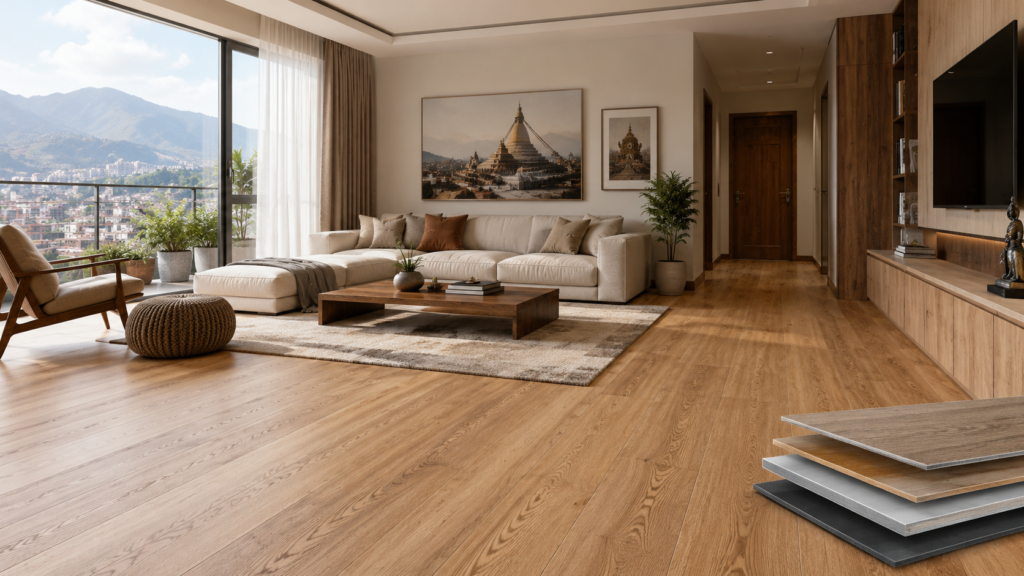
SPC waterproof flooring has become one of the most practical flooring choices for modern homes, apartments, offices and renovation projects in Nepal. It gives a wooden-floor look, but unlike normal HDF laminate or parquet flooring, it handles moisture much better. For Kathmandu, Lalitpur, Bhaktapur, Pokhara and other cities where monsoon humidity, bathroom leakage, seepage and cleaning water are real issues, this is the main reason many homeowners now ask about SPC flooring before choosing traditional parqueting.
This guide explains SPC flooring price in Nepal, common brands and supplier categories, installation cost, pros and cons, and how SPC compares with HDF flooring, laminate flooring, vinyl flooring, tiles and normal wooden parqueting. If you are planning a new house, apartment interior or renovation, also check our flooring price in Nepal guide and types of flooring in Nepal comparison.
What is SPC Flooring?
SPC means Stone Plastic Composite or Stone Polymer Composite. It is a rigid plank flooring made by combining stone powder, PVC and stabilizers. The result is a dense, strong and waterproof flooring board that usually comes with a printed wood or stone finish on top.
A typical SPC flooring plank has these layers:
- UV coating: protects the surface from fading and stains.
- Wear layer: protects against scratches, chair movement and daily foot traffic.
- Decorative film: gives the wooden, stone or textured design.
- SPC rigid core: limestone and polymer-based core that gives strength and water resistance.
- IXPE/EVA underlay: optional foam backing for sound reduction and comfort.
The most important difference is the core. HDF laminate/parquet flooring uses a wood-fibre core, which can swell when water enters the board. SPC uses a rigid stone-polymer core, so it is much safer in moisture-prone areas.
SPC Flooring Price in Nepal 2026
In Nepal, SPC flooring price usually depends on thickness, wear layer, brand, underlay, locking quality, texture and installation scope. For normal residential use, many market options fall around NPR 200 to NPR 800 per sq ft, while premium imported collections may go higher. Basic online/listing prices can appear lower, but the final installed cost may increase after adding skirting, profiles, floor preparation and wastage.
| SPC flooring type | Approx. material price in Nepal | Best use case | What to check before buying |
|---|---|---|---|
| Budget SPC flooring | NPR 180–300 per sq ft | Rental rooms, small offices, low-budget renovation | Locking strength, plank thickness, warranty and surface finish |
| Mid-range SPC flooring | NPR 300–700 per sq ft | Bedrooms, living rooms, apartments, normal homes | 4–6 mm thickness, wear layer, underlay and skirting cost |
| Premium SPC flooring | NPR 700–1,200+ per sq ft | Premium homes, hotels, showrooms, high-traffic interiors | Brand warranty, acoustic backing, embossed texture and fire rating |
| Installation labour | NPR 30–80 per sq ft | Click-lock plank installation | Floor level, cutting complexity, room shape and installer experience |
| Accessories | Varies by project | Skirting, T-profile, reducer, beading, edge finishing | Colour matching and per-running-foot rate |
Practical budget example: For a 120 sq ft bedroom, if you choose mid-range SPC at NPR 450/sq ft and installation at NPR 50/sq ft, your basic flooring cost becomes around NPR 60,000 before adding skirting, profiles, floor levelling and wastage. Always ask the supplier for a full quotation, not only the material rate.
SPC Flooring Brands and Suppliers Available in Nepal
Nepal’s flooring market includes imported SPC, local distributors, interior suppliers and online sellers. Availability changes frequently, so treat the following as a market reference rather than a fixed brand list. Before finalizing, visit the showroom, see the physical sample, ask for warranty and confirm the batch availability.
| Brand / supplier category | Market positioning | Typical features offered | Good for |
|---|---|---|---|
| Inovar-type SPC / laminate suppliers | Mid to premium segment | Better design range, branded planks, showroom support | Homes, apartments and semi-premium interiors |
| Gerflor / premium imported resilient flooring | Premium commercial/residential | Higher finish quality, stronger technical specification, better warranty support | Hotels, offices, clinics, premium homes |
| Welspun / Indian SPC-style products | Budget to mid-range depending on supplier | Wood-look planks, 5–6 mm options, click-lock installation | Residential rooms and renovation |
| Gem Flooring / interior flooring suppliers | Multi-product showroom segment | Laminate, vinyl plank, sports and heavy-duty flooring options | Clients comparing multiple flooring materials |
| Local Kathmandu flooring shops | Budget to mid-range | SPC, HDF laminate, skirting and installation package | Fast availability and local installer support |
| Online marketplace sellers | Price-focused | Lower entry prices, limited showroom experience | Small projects if sample and quality are verified first |
For HDF and laminate alternatives, Nepal market commonly includes brands and suppliers such as Action Tesa, Greenpanel, Sunrise, Tusha, Trade Nepal-type suppliers and local parqueting shops. These can be cheaper than SPC, but moisture protection is the key difference.
SPC Flooring vs HDF Laminate / Parquet Flooring in Nepal
In Nepal, many people call laminate flooring “parqueting” or “wooden parquet,” even when it is actually HDF laminate. It looks good and is budget-friendly, but it is not the same as waterproof SPC flooring.
| Feature | SPC flooring | HDF laminate / normal parqueting | Vinyl flooring | Tiles |
|---|---|---|---|---|
| Water resistance | Excellent; suitable for moisture-prone rooms | Poor to moderate; swelling risk if water enters joints | Good, but depends on quality and subfloor | Excellent surface resistance |
| Look and feel | Wood/stone look, firm underfoot | Warm wooden look, comfortable | Softer and flexible | Hard, cold and permanent |
| Installation speed | Fast click-lock | Fast click-lock | Fast but subfloor-sensitive | Slower; cement adhesive/grout needed |
| Repairability | Individual plank replacement possible | Possible, but water damage may spread | Depends on product type | Tile replacement is possible but messy |
| Best area | Bedroom, living, kitchen, apartment, office | Dry bedrooms and low-moisture rooms | Budget rooms, temporary flooring | Bathroom, kitchen, balcony, heavy wet areas |
| Main weakness | Needs level subfloor; can feel less natural than wood | Not safe for leakage and wet mopping | Can dent/tear if low quality | Can feel cold, slippery and may crack/chip |
Simple recommendation: Choose HDF laminate/parquet only for dry rooms where you want a lower budget wooden look. Choose SPC when you want a similar wooden look with much better protection against water, seepage and Nepal’s monsoon humidity.
Where Should You Use SPC Flooring?
SPC flooring is especially useful in areas where you want a premium wooden look but do not want the maintenance issues of real wood or HDF laminate.
- Bedrooms: gives a warm interior look and is easier to clean than carpet.
- Living rooms: good for apartments and modern homes where interior finish matters.
- Kitchens: safer than HDF laminate because spills are common.
- Home offices: handles rolling chairs better if the wear layer is good.
- Commercial interiors: useful for showrooms, clinics, salons, offices and studios.
- Renovation projects: quick installation over existing level floors, depending on site condition.
For bathrooms, balconies and outdoor wet areas, tiles are still usually safer because they handle standing water, drainage slope and long-term wet exposure better. SPC can handle water on the surface, but the room detail, slope, edge sealing and subfloor condition matter a lot.
Features to Check Before Buying SPC Flooring in Nepal
Do not buy SPC flooring only by looking at the colour. Two planks may look similar in a showroom but perform very differently after installation.
| Specification | What it means | Recommended for Nepali homes |
|---|---|---|
| Total thickness | Overall plank thickness including core/backing | 4 mm minimum; 5–6 mm feels better |
| Wear layer | Transparent protective layer on top | 0.3 mm for home use; 0.5 mm for heavy use |
| Underlay | Foam backing for comfort and sound reduction | IXPE/EVA backing is useful in apartments |
| Click-lock quality | How tightly planks connect | Check sample joints before buying |
| Surface texture | Matte, embossed, wood grain or smooth finish | Matte/embossed hides scratches better |
| Warranty | Supplier support after installation | Ask for written warranty and invoice |
| Fire and slip rating | Safety performance | Important for offices, kitchens and commercial spaces |
Installation Cost and Site Preparation
SPC flooring installation is faster than tile work because it usually uses a floating click-lock system. However, the floor below must be clean, dry and reasonably level. If the subfloor has waves, dust, hollow patches or old moisture issues, the planks may move, click sound may come, or joints may open later.
Before installation, check these points:
- Floor level should be corrected before laying SPC.
- Old seepage or leakage must be fixed first.
- Leave expansion gaps at walls and cover with skirting.
- Use proper transition profiles at doorways and tile junctions.
- Order 5–10% extra material for cutting wastage.
- Confirm whether skirting, beading and door cutting are included in the quotation.
If your house is still under construction, plan flooring only after wet works, wall putty/paint base, electrical chasing, plumbing testing and major carpentry dust work are completed. For full construction budget planning, use our construction cost calculator Nepal and read the per sq ft construction cost in Nepal guide.
Advantages of SPC Waterproof Flooring
- Waterproof core: better for Nepal’s monsoon, kitchen spills and damp apartments.
- Wooden appearance: gives a warmer interior look than normal tiles.
- Quick installation: no cement curing time like tile flooring.
- Low maintenance: regular sweeping and damp mopping is enough.
- Good dimensional stability: less swelling risk compared with HDF laminate.
- Comfort: warmer and softer underfoot than tiles.
- Renovation-friendly: can be installed quickly if the existing floor is level.
Disadvantages of SPC Flooring
- Not a replacement for waterproofing: SPC handles surface water, but it will not fix slab leakage or wall seepage.
- Needs a level floor: uneven floors can cause joint noise and movement.
- Can scratch: it is scratch-resistant, not scratch-proof. Use chair pads and furniture protectors.
- Lower natural feel than real wood: the look is realistic, but it is still an engineered product.
- Quality varies a lot: cheap planks may have weak locks, thin wear layers or poor printing.
- Heat and direct sunlight: large sunny windows may need curtains/blinds to reduce expansion and fading risk.
SPC Flooring vs Tiles: Which is Better?
Tiles are still the strongest choice for bathrooms, balconies, utility areas and places with drainage slopes. They handle standing water and heavy cleaning very well. SPC flooring is better when you want a warm wooden look, faster installation and more comfortable walking surface in bedrooms, living rooms and apartments.
For most Nepali homes, a practical combination is:
- Tiles: bathroom, balcony, terrace, puja wash area and heavy wet areas.
- SPC flooring: bedroom, living, dining, kitchen and home office.
- HDF laminate/parquet: dry bedrooms and budget rental spaces.
- Granite/marble: staircase and high-durability common areas if budget allows.
If you are comparing staircase material, read our related flooring and renovation guides before deciding because stairs need anti-slip safety, nosing detail and long-term edge durability.
Maintenance Tips for SPC Flooring
- Clean dust regularly with a broom, vacuum or microfiber mop.
- Use a damp mop; avoid flooding the floor unnecessarily.
- Do not use harsh chemicals, acid cleaners or abrasive scrubbers.
- Use felt pads under furniture legs.
- Keep doormats at entrance areas to reduce sand scratches.
- Lift heavy furniture instead of dragging it.
- Repair plumbing leakage quickly even if the SPC surface is waterproof.
Is SPC Flooring Worth It in Nepal?
SPC flooring is worth it in Nepal if you want a wooden interior look but are worried about moisture, seepage, monsoon humidity and daily cleaning. It is especially useful for apartments, bedrooms, living rooms, kitchens and renovation projects. Compared with HDF laminate or normal parqueting, SPC usually costs more, but it gives better moisture safety and longer practical life in damp conditions.
However, SPC is not automatically the best option for every room. For full wet bathrooms, balconies and outdoor spaces, tiles are still safer. For very low-budget dry bedrooms, HDF laminate may be enough. The right choice depends on your room use, moisture risk, budget and desired interior finish.
Buyer Checklist Before Finalizing SPC Flooring
- Ask for physical samples, not only catalogue photos.
- Compare at least 3 suppliers with the same thickness and wear layer.
- Confirm whether the price includes VAT, installation, skirting and profiles.
- Check the click-lock system by joining two sample planks.
- Ask for warranty in writing.
- Check if matching skirting is available.
- Confirm stock availability for future repair.
- Do not install before fixing leakage, seepage or uneven flooring.
FAQs About SPC Flooring in Nepal
What is the price of SPC flooring in Nepal?
SPC flooring price in Nepal commonly starts around NPR 180–300 per sq ft for budget options and can reach NPR 700–1,200+ per sq ft for premium imported products. Installation, skirting and profiles are usually extra.
Is SPC flooring waterproof?
Yes, SPC flooring has a waterproof rigid core, so it is much safer than HDF laminate in moisture-prone rooms. However, the subfloor, wall seepage and edge finishing still matter.
Is SPC better than normal parqueting?
For moisture resistance, SPC is better than normal HDF laminate/parqueting. For the most budget-friendly dry-room wooden look, HDF laminate may still be cheaper.
Can SPC flooring be used in kitchens?
Yes, SPC flooring is a good option for kitchens because it handles spills better than HDF laminate. Still, plumbing leakage should be repaired quickly and water should not be left standing for long periods.
How long does SPC flooring last?
Good quality SPC flooring can last 10–20 years or more depending on wear layer, installation quality, room traffic and maintenance.
Final Recommendation
For most modern Nepali interiors, SPC waterproof flooring is a strong middle option between budget HDF parqueting and permanent tile flooring. It is stylish, fast to install, easier to maintain and much safer in moisture-prone homes. The best value usually comes from choosing a mid-range SPC plank with a decent wear layer, proper underlay, good locking system and experienced installer.
If you are designing or renovating a house in Nepal and want help choosing flooring, interior finishes and construction materials, explore AS Design’s house design in Nepal, home interior design cost guide, and house construction process in Nepal resources.