By House Design in Nepal | housedesigninnepal.com Last updated: May 2026 | Reading time: 14 min | All prices in NPR — Kathmandu Valley 2026 market rates
Quick answer: A complete modular kitchen in Nepal costs NPR 4.3 lakhs (standard) to NPR 21.9 lakhs (luxury). A local carpenter kitchen costs NPR 3.25–5 lakhs. The price gap is smaller than most people think — and the quality gap is not where most people expect it to be.
The Question Every Kathmandu Homeowner Gets Wrong
Most homeowners frame this decision as: “Modular is expensive, carpenter is affordable — so carpenter unless I have money to burn.”
That framing is wrong. And it costs people money.
The real question is: what fails first, and how much does it cost to fix?
A local carpenter kitchen built with the wrong materials in Nepal’s climate fails in 3–5 years. A modular kitchen with the wrong hardware fails in 18 months. A carpenter kitchen with marine ply and Hettich hardware costs nearly the same as entry modular — and lasts just as long. A mid-range modular kitchen with full interior fittings transforms how you use your kitchen every day.
This article gives you the honest comparison — not a sales pitch for either side. We design kitchens in Kathmandu every week. We’ve seen both approaches succeed and fail. Here is what actually matters.
What “Modular Kitchen” Actually Means in Nepal’s Market
Walk into kitchen showrooms in Maharajgunj, Putalisadak, or New Baneshwor and you will find three completely different things all labelled “modular kitchen”:
True modular (factory-manufactured): Cabinet boxes cut in a factory to precise dimensions, edge-banded on all sides, assembled on-site with imported hardware. The word “modular” technically means this. Carcass is BWP marine ply. Hardware is Hettich, Hafele, or Ebco. This is what this article means when it says modular.
Semi-modular (site-made with modular aesthetics): A carpenter builds the boxes on-site using locally cut ply. Factory-made acrylic or laminate shutter panels are applied to achieve a modular look. Hardware varies — sometimes Hettich, sometimes local copy. Quality depends entirely on the individual carpenter.
Carpenter-with-acrylic (wrongly called modular): A carpenter builds everything on-site, applies high-gloss acrylic for the shiny finish, and calls it modular. The carcass is often MDF or low-grade ply. This is the most common source of kitchen failure in Kathmandu — homeowners pay a near-modular price and get a non-modular result.
Know this before you get quotes: Ask every contractor or company: “Is the carcass factory-cut or site-cut? What grade of plywood? Which brand of hinges and drawer channels?” If they cannot answer clearly, walk away.
Full Cost Breakdown — Every Line Item
Based on a standard L-shape kitchen with breakfast bar, 10ft countertop, full appliances. Kathmandu Valley 2025.
| Item / Category | Local Carpenter | Modular — Standard | Modular — Mid-Range | Modular — Luxury |
|---|---|---|---|---|
| Cabinet system (base + wall + tall units) | 95,000–1,20,000 | 1,47,000 | 2,96,000 | 5,60,000 |
| Soft-close hinges + full-extension drawer channels | 8,000–18,000 | 20,000 | 44,000 | 80,000 |
| Interior fittings (magic corner, pull-outs, bins, trays) | 12,000–25,000 | 25,000 | 59,000 | 1,17,000 |
| Quartz countertop (10ft) + breakfast bar overhang | 28,000–55,000 | 47,000 | 95,000 | 1,90,000 |
| 1.5 bowl SS304 sink + pull-out tap + RO tap + RO unit | 22,000–38,000 | 32,000 | 68,000 | 1,45,000 |
| 4-burner gas hob + ducted chimney + ducting work | 32,000–48,000 | 46,000 | 94,000 | 1,87,000 |
| Refrigerator 350–500L + microwave (built-in) + OTG | 70,000–1,10,000 | 90,000 | 1,60,000 | 3,05,000 |
| Dishwasher (optional) | — | — | 60,000 | 1,20,000 |
| Backsplash tile + anti-slip floor tile + labour | 22,000–38,000 | 38,000 | 83,000 | 1,65,000 |
| Under-cabinet LED + pendant lights + recessed spots | 18,000–30,000 | 28,000 | 58,000 | 1,27,000 |
| Breakfast bar stools ×2 | 6,000–12,000 | 8,000 | 18,000 | 40,000 |
| Electrical (MCBs, ELCB, sockets) + plumbing + gas line | 35,000–55,000 | 48,000 | 90,000 | 1,57,000 |
| TOTAL | ~3.28–5.49 lakhs | ~4.29 lakhs | ~10.25 lakhs | ~21.93 lakhs |
Related reading: See how the kitchen fits into your total home budget in our Complete Home Interior Design Cost Guide Nepal 2025–2026 — it covers all 14 rooms across three budget tiers.
The Five Things That Actually Determine Quality
Most homeowners focus on the visual — door finish, handle style, countertop colour. These matter, but they are not what determines whether a kitchen lasts 5 years or 20 years in Nepal’s conditions. These five things are.
1. The Carcass Material — Where Kitchens Actually Fail
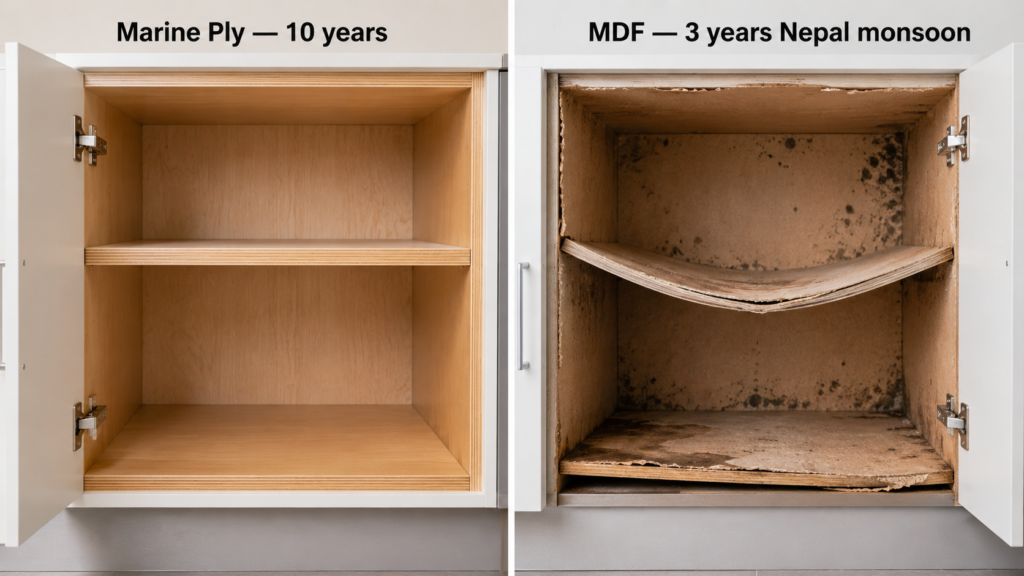
The carcass is the cabinet box — the internal structure behind the door. Nobody sees it once the kitchen is installed. It is the single most important quality decision you make.
BWP marine ply (Boiling Water Proof): The only carcass material suitable for Nepal’s kitchen environment. Resistant to the sustained humidity of the monsoon, the steam from daily pressure cooker use, and the occasional water splash from the sink. Look for ISI certification and the “BWP” grade stamp on the sheet. Available from reputable timber yards in Teku and Kalimati, Kathmandu.
MDF (Medium Density Fibreboard): Absorbs moisture and swells. In Nepal’s 5-month monsoon, an MDF carcass behind a kitchen base unit will begin swelling at the bottom shelf within 2–3 monsoon seasons. Once it swells, the door alignment goes. Once the door alignment goes, the hinges are under uneven load and fail faster. The failure chain is slow, invisible, and inevitable.
Particle board / local ply: Similar failure profile to MDF in moisture. Often used by unqualified contractors to cut cost. Ask to see the sheet before it goes into your kitchen.
The test: Ask your contractor to show you the plywood before installation. A legitimate supplier will show you the sheet with the BWP grade stamp. A contractor who resists this question is using the wrong material.
2. Edge Banding — The Detail That Separates Modular From Carpenter
This is where factory modular and site-built carpenter kitchens most frequently diverge — and it is invisible until it fails.
Every cut edge of every plywood sheet must be sealed with edge banding — a thin strip of material (usually PVC or ABS) applied to the edge to prevent moisture penetration. Factory-cut modular cabinets are edge-banded on all four sides of every panel, applied with precise heat and pressure in the factory.
Site-built carpenter kitchens frequently have unsealed edges on internal shelves, the backs of cabinets, and the underside of wall units. These open edges absorb humidity during the monsoon. The ply swells. The shelf sags. The delamination begins from the inside out, invisible until the shelf collapses or the drawer stops running true.
A skilled, quality-conscious carpenter can and does edge-band properly. Many do not, because it adds time and they are competing on price. This is the conversation to have before you sign any carpenter contract.
3. Hardware — Hettich vs Local Copy
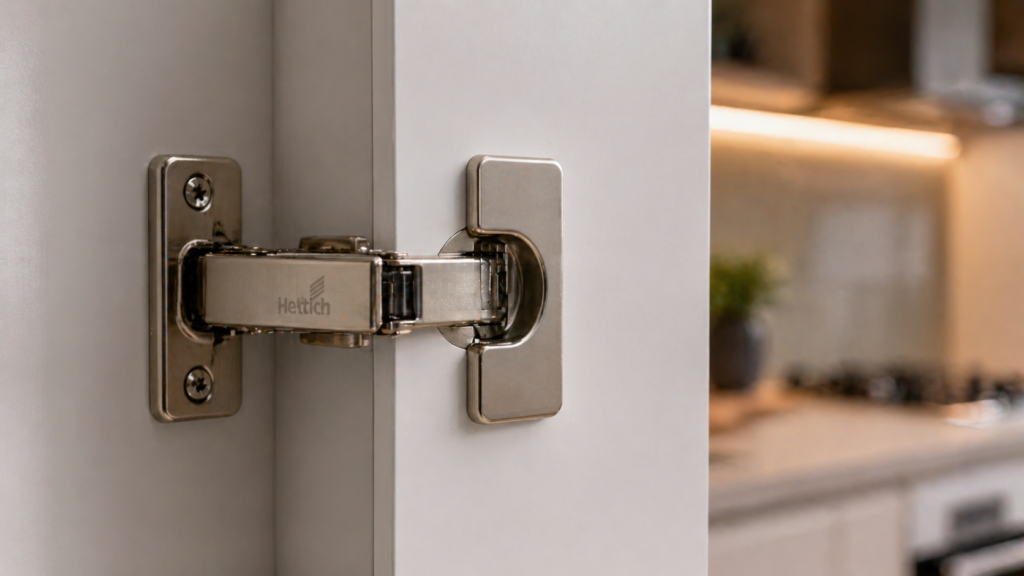
This is the most impactful quality decision in any kitchen — modular or carpenter — and it is where most Kathmandu homeowners are misled.
Hettich (Germany) soft-close hinges: A kitchen drawer closes with a quiet, controlled deceleration. A cabinet door pushed firmly swings to within 2cm of closed and then draws itself gently shut. This is what Hettich hardware does. It still does this after 10 years and 50,000 cycles. It is available from authorised Hettich distributors in Kathmandu.
Local copy hinges (sold in Ason and hardware markets): Visually identical to Hettich at installation. Within 12–18 months: the soft-close mechanism weakens. Doors start closing with a click instead of a whisper. By month 24, some hinges are drooping — the door hangs slightly lower than it should, the gap at the top is wider than the gap at the bottom. By month 36, you are adjusting hinges every few months and some have been replaced.
The price difference per hinge: Hettich is approximately NPR 350–550 per hinge. Local copies are NPR 80–150. For a full kitchen of 40 hinges, the difference is approximately NPR 11,000–17,000. That NPR 15,000 difference is the best value-for-money decision in the entire kitchen.
The same logic applies to drawer channels. Hettich full-extension undermount channels let the drawer come fully out so you can reach everything at the back. Local copy channels extend 75–80% and start sticking within 18 months.
Insist on this in writing: Your contract should specify “Hettich soft-close hinges” and “Hettich full-extension drawer channels” by brand name. “Soft-close hardware” without a brand name means whatever the contractor has in stock — usually local copies.
4. Interior Fittings — The Upgrade That Changes How You Cook
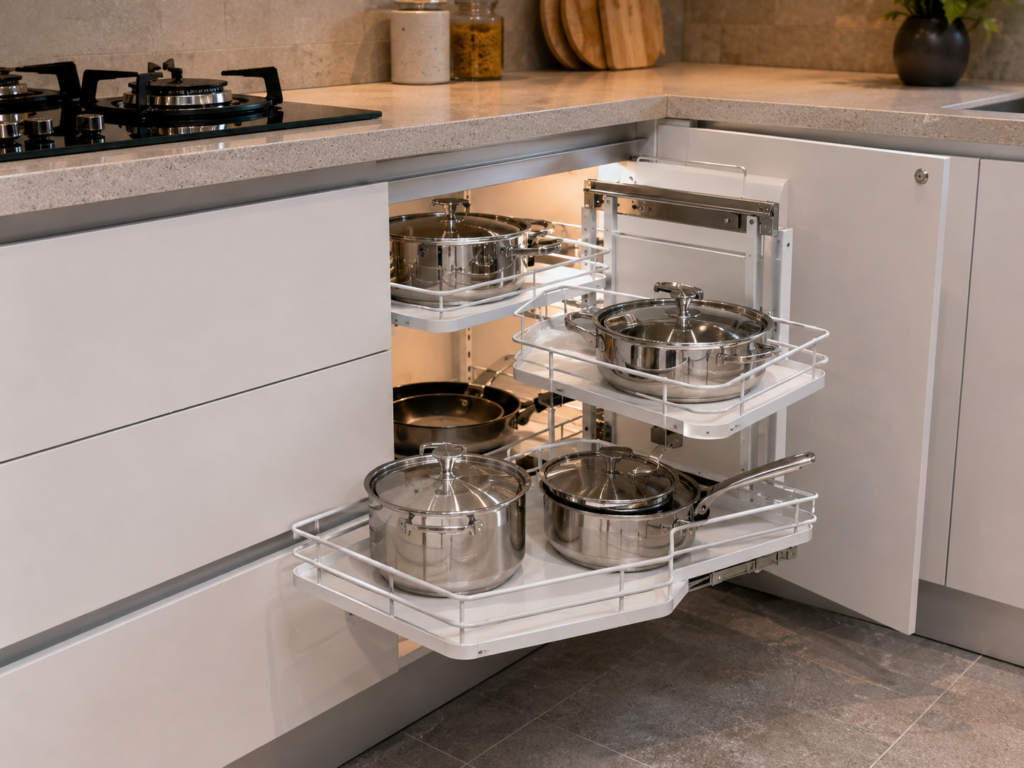
This is where modular kitchens pull decisively ahead of basic carpenter kitchens — not in carcass quality, not in finish, but in functional intelligence.
Magic corner pull-out: A hinged bracket system that gives you full access to a corner cabinet that would otherwise be a dead zone. In a standard L-shape kitchen, the corner cabinet is typically 900×900mm — a significant volume of space. Without a magic corner, perhaps 40% of this space is usable (you have to reach in and around). With a magic corner pull-out, 90%+ is usable and everything is visible. Cost: NPR 8,000–18,000.
3-stack deep drawers vs shelves in base cabinets: Traditional base cabinets have shelves. You bend down, reach to the back, and can’t see or reach what’s behind the front item. Deep drawers that pull fully out mean everything is visible and accessible. For heavy Nepali cooking vessels — pressure cookers, kadais, tawa — this is transformative. Cost: included in mid-range and above modular; add NPR 15,000–25,000 to specify for a carpenter kitchen.
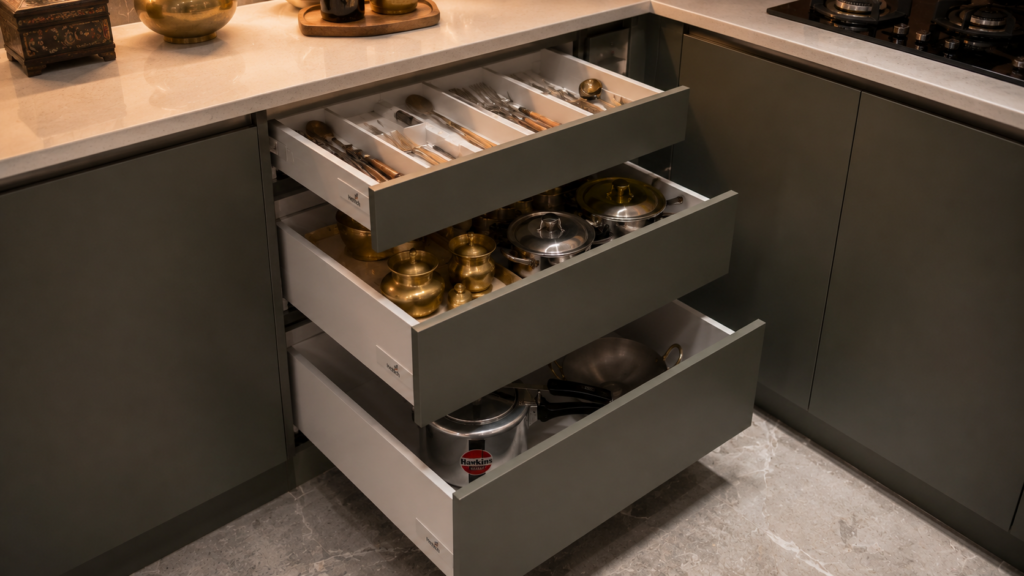
Pantry tower pull-out: A full-height column cabinet with pull-out shelves that give you floor-to-ceiling organised pantry storage. Every jar, every spice, every bottle visible from the front. Cost: NPR 12,000–22,000 for the fitting.
Dual waste bin pull-out: A cabinet drawer that opens to reveal two bins — one for general waste, one for recyclable or organic waste. Keeps the bins hidden, accessible, and odour-contained.
A carpenter kitchen can incorporate all of these fittings. The question is whether your carpenter sources them and installs them correctly, and whether the cost of adding them to a carpenter quote brings you close enough to modular pricing that modular becomes the obvious choice.
5. Countertop — The Surface You Use Every Day
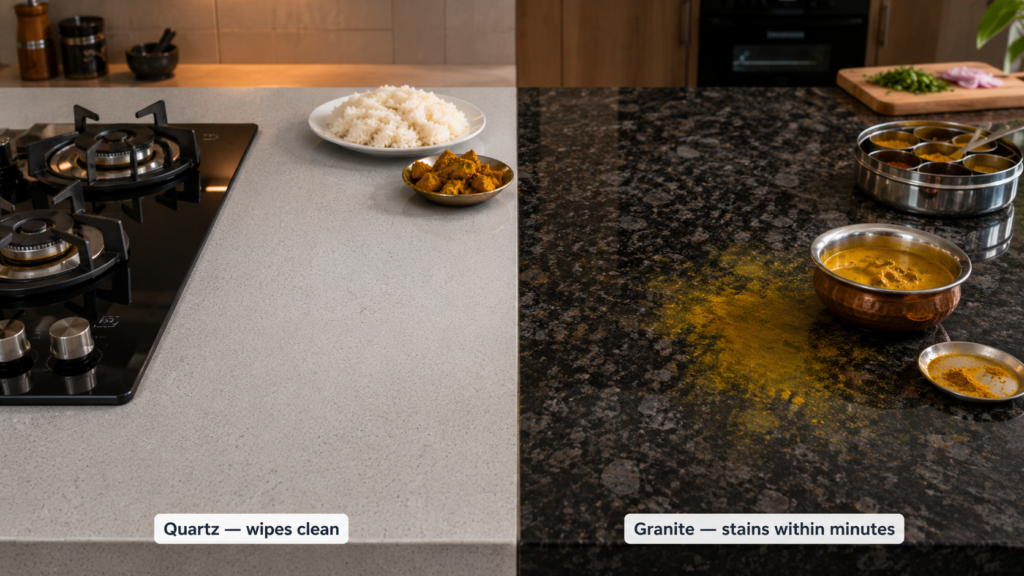
Quartz (recommended): Non-porous — turmeric, curry oil, and hot tea do not penetrate the surface. Wipe with a cloth and it is clean. No sealing required. Handles heat to approximately 150°C without damage. Consistent appearance throughout — no veining variations to manage. Available in Kathmandu from NPR 47,000 for a 10ft standard kitchen section.
Granite (common but problematic): Natural stone with microscopic pores. Turmeric stains penetrate within minutes if not wiped immediately. Requires annual sealing to maintain stain resistance. The sealing is usually skipped after year one. By year three, most unsealed granite kitchen counters in Nepal show turmeric staining in the pores near the hob. Available from local stone suppliers in Kathmandu for slightly less than quartz.
Stainless steel (practical for heavy cooking): Zero stain risk, heat-proof, hygienic. Common in commercial kitchens. Increasingly used as a dedicated prep section alongside a quartz main counter in serious home kitchens. Scratches visibly but does not stain. A stainless prep section beside the hob is a practical addition for any Nepali household that cooks seriously.
Recommendation: Quartz as the primary countertop. Add a stainless section (600×600mm) adjacent to the hob for hot vessel placement and spice work. This combination handles Nepal’s cooking style better than any single material.
Real Case Study — The Tuladhar Family, Patan (2022–2024)
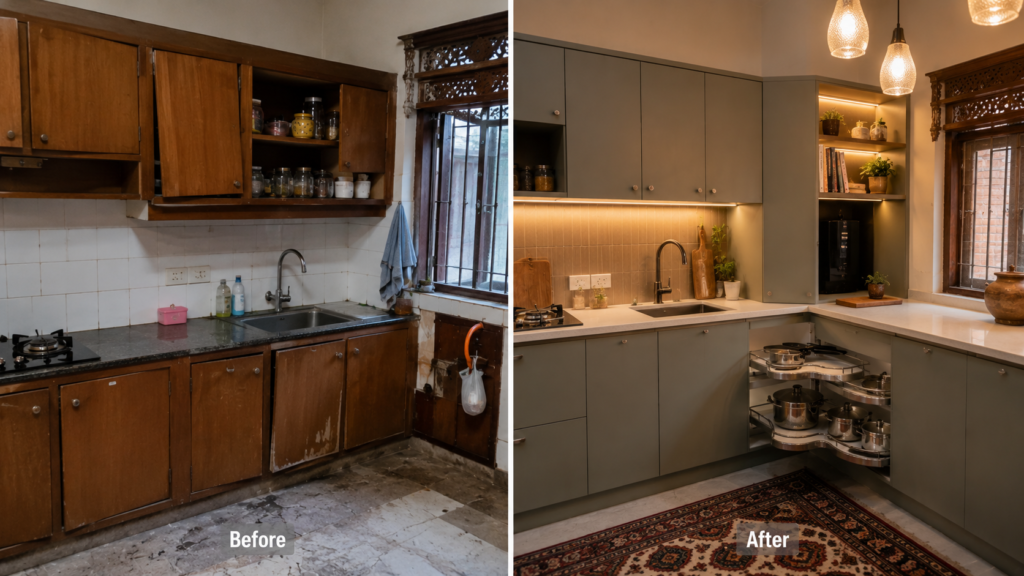
Bikram and Aakriti Tuladhar were renovating their Patan home — a converted Newari house with a kitchen that had one angled wall, a recessed niche above the water storage tank, and a ceiling at 2.85m.
Decision 1 — Local carpenter (2022): NPR 3.8 lakhs
The carpenter was experienced, had good references, and used marine ply for the carcass. The initial finish looked sharp — high-gloss acrylic doors, stainless undermount sink, decent chimney.
What went wrong:
- Month 14: Three cabinet doors had dropped and needed hinge adjustment. Local copy hinges.
- Month 17: Two drawer channels sticking. The bottom drawer in the base unit beside the sink stopped extending fully.
- Month 19: The shelf inside the base cabinet below the sink showed the beginning of edge delamination. The edge had not been banded on the internal horizontal shelf — the carpenter had banded the visible exterior edges only.
- Ongoing: The corner cabinet was effectively dead space. Without a magic corner, the family stored rarely-used items there and essentially treated it as a cupboard they never opened.
What it cost to fix: NPR 35,000 in hardware replacement and adjustment over 24 months. The delaminating shelf was left because full repair would require removing the countertop.
Decision 2 — Modular kitchen (2024): NPR 9.8 lakhs
We were called in after the 24-month frustrations. The new kitchen was specified as follows:
- Factory modular carcasses in 18mm BWP marine ply, factory edge-banded all sides
- Hettich soft-close hinges and full-extension undermount drawer channels throughout
- Magic corner pull-out for the angled corner (the 2022 carpenter had simply built a fixed-shelf cabinet there, wasting approximately 0.4 sq m of usable volume)
- 3-stack deep drawers in all base cabinets
- Pantry tower pull-out in the tall unit
- Quartz countertop, 10ft, with 300mm breakfast overhang
- The recessed tank niche was designed as an open display shelf above — plain-painted recess with a small LED strip, displaying cookbooks and plants
- Jaquar pull-out mixer tap, SS304 1.5-bowl undermount sink, under-sink RO
Total: NPR 9.8 lakhs including appliances, electrical, tiling and plumbing.
Two years later (2026): Not one hinge adjusted. Not one drawer sticking. The magic corner pull-out is used daily. Aakriti’s assessment: “We spent NPR 13.6 lakhs total on this kitchen — NPR 3.8L on the first one and NPR 9.8L on the second. If we had spent NPR 9.8L the first time, we would have a better kitchen and saved NPR 3.8L. The lesson was expensive.”
When Local Carpenter Is the Right Choice
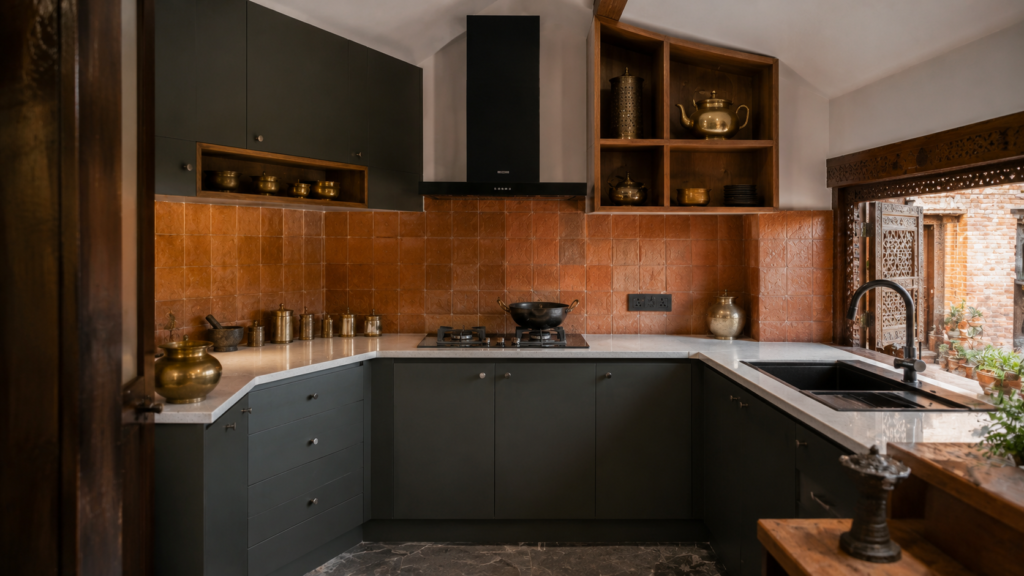
We design kitchens in Kathmandu every week. We recommend modular often — but not always. Here is when a skilled local carpenter is genuinely the better call:
Non-standard dimensions: Nepali homes — especially older buildings in Thamel, Patan, Bhaktapur, and Kirtipur — rarely have standard kitchen dimensions. Columns mid-kitchen, angled walls, ceiling beams, recessed niches. Factory modular cabinets are built to standard sizes (600mm deep, 720mm base height). Custom sizing from a modular company costs a significant premium and takes longer. A carpenter builds to your exact dimensions as a matter of course.
Budget firmly below NPR 3.5 lakhs: True modular with appliances starts around NPR 4.3 lakhs. Below that, a skilled carpenter using marine ply and specified Hettich hardware is the better value proposition.
Proven carpenter with verifiable references: If you have a carpenter whose kitchen work you have seen in a friend’s home — walked into, opened drawers, cooked in — and it is good after 3+ years, that is more reliable than a modular company whose showroom kitchen looks flawless but whose site work you haven’t seen.
Unique design requirements: A live-edge wood island, a custom open shelf display section, integration of a family heirloom piece — a carpenter solves these naturally. A modular company makes them work at significant extra cost.
When Modular Is the Right Choice
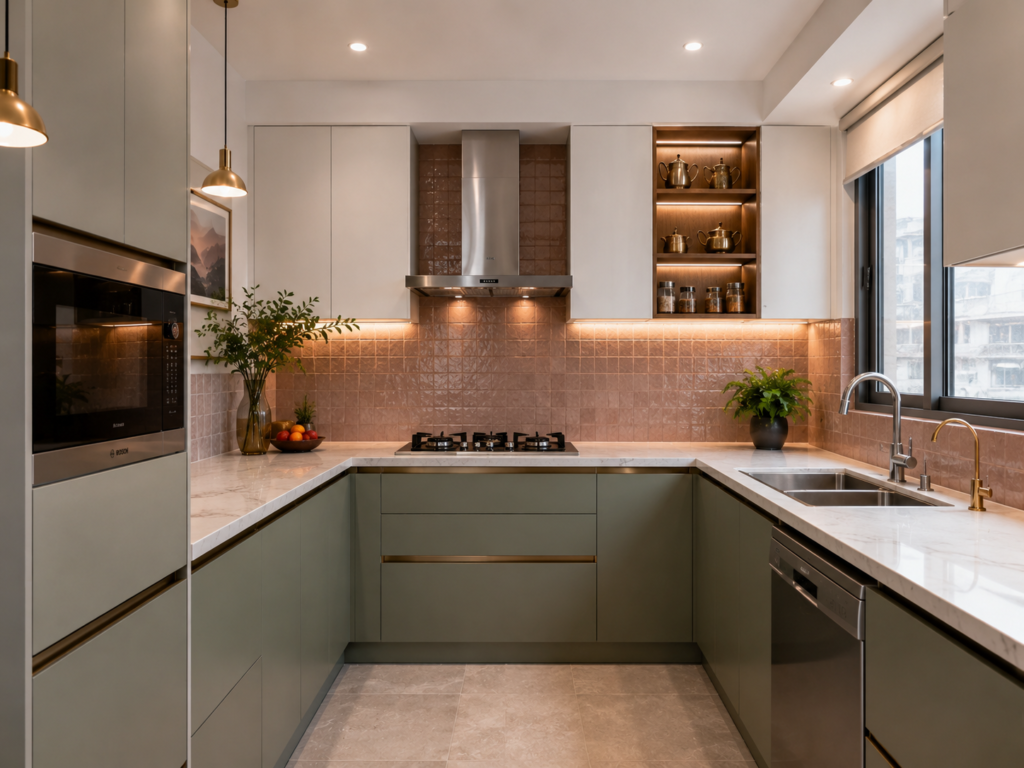
Daily Nepali cooking: High heat, heavy pressure cookers, aromatic spices, dal splatter, turmeric everywhere. The sealed factory-finished interiors of a modular system handle this better than open-edge carpenter work. The stainless prep section and quartz countertop combination is designed for exactly this cooking style.
You want specialist fittings without negotiation: Magic corners, pantry towers, 3-stack drawers, internal bin systems, pull-out spice racks — these are catalogue items in a modular system. You point, they supply. Getting the same from a carpenter requires sourcing the fittings yourself (or trusting the carpenter to source them) and paying for custom integration.
Standard kitchen dimensions: If your kitchen was designed at the blueprint stage to standard dimensions, factory modular is straightforward, fast, and consistent.
You cannot supervise the build closely: Factory modular requires less on-site supervision than carpenter work. The manufacturing quality control happens in the factory. With carpenter work, the quality control happens on your site — daily. If you’re not available to check the work at each stage, modular reduces your exposure to variation.
The Non-Negotiables — Regardless of Which Route You Choose
These specifications apply whether you go modular or carpenter. They are the minimum standard for a kitchen that survives Nepal’s conditions.
Carcass: 18mm BWP marine ply (ISI-certified, BWP grade). Not MDF, not particle board, not commercial ply. Ask to see the sheet with the grade stamp before it enters your home.
Hardware: Hettich or Ebco soft-close hinges and full-extension drawer channels. Get this in writing by brand name in your contract. “Soft-close” without a brand name means nothing.
Countertop: Quartz (non-porous, turmeric-resistant, zero sealing required). If budget is tight, use quartz on the main counter and a laminate or locally fabricated granite section for the breakfast overhang.
Sink: SS304 grade (not SS202). 1.5-bowl undermount — no rim, no accumulation of water and food debris at the base. Pull-out spray mixer tap minimum.
Chimney: Ducted (exhausts outside) not recirculating. If your building has no existing duct shaft, price the ductwork — NPR 8,000–18,000 — and add it. A recirculating chimney does not remove grease, steam, or cooking fumes adequately for a Nepali kitchen.
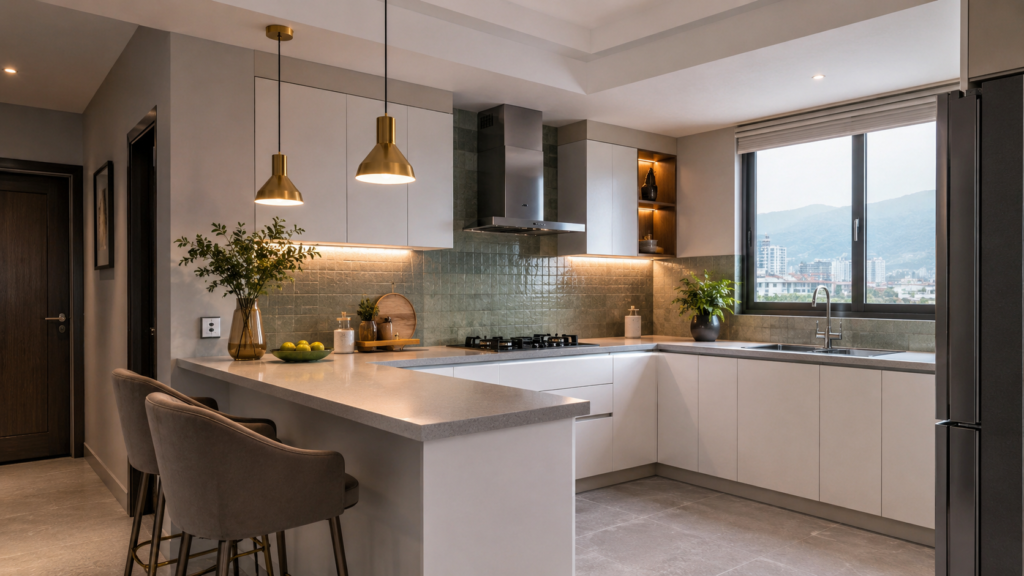
RO water purifier: Under-sink unit, essential for Kathmandu’s urban water supply. The RO tap should be positioned at the same height as the main mixer — not attached as an afterthought to the side of the sink. Plan the under-sink space and drainage before the cabinet is installed.
Backsplash tile first: The backsplash tile must be laid before the cabinets are installed if you want a clean finish. Tiling around installed cabinet frames is messy, difficult, and looks amateurish. Sequence: waterproofing → tiling → cabinet installation → countertop → sink → appliances.
ELCB protection: All kitchen sockets must be ELCB (Earth Leakage Circuit Breaker) protected. This is a safety requirement, not optional. Any electrician who resists this should be replaced.
For a complete room-by-room electrical planning guide, see our Socket Placement Guide for Nepali Homes — kitchen sockets must be 150mm above the counter surface, not at floor level.
The Kathmandu Showroom Trap
A note on showroom kitchens in Kathmandu specifically.
Most kitchen showrooms on the Maharajgunj–Ring Road corridor and in New Baneshwor display a showcase kitchen that is installed to a high standard using good materials. The question is whether the kitchen installed in your home is built to the same standard.
Before committing to any modular kitchen company in Kathmandu:
- Ask for three client references — not Instagram photos, but actual homes you can visit and the homeowner’s phone number. Call them. Ask if the installation quality matched the showroom.
- Ask how long the company has been operating. Kitchen showrooms in Kathmandu have a history of opening, selling kitchens, and closing before the warranty period ends. A company that has been operating for 5+ years with consistent references is meaningfully lower risk than a new showroom with a beautiful display.
- Get the warranty in writing. What does it cover? Hardware only? Carcass? What is the claims process? A warranty clause that requires you to bring the cabinet to their showroom (impossible once installed) is not a warranty.
- Visit an installation in progress. A company confident in their site work will invite you to see a kitchen being installed. One that deflects this request has something to hide.
Frequently Asked Questions
How much does a modular kitchen cost in Nepal in 2025?
A complete modular kitchen in Nepal costs NPR 4.29 lakhs (standard) to NPR 21.93 lakhs (luxury). Mid-range — the most popular tier for design-conscious Kathmandu homeowners — runs NPR 10–12 lakhs including all appliances, electrical, and plumbing.
Is modular kitchen better than local carpenter in Nepal?
For most families doing daily Nepali cooking, a true modular kitchen with BWP marine ply carcass and Hettich hardware outperforms carpenter work on moisture resistance, fit, and functional storage within 2–3 years. For non-standard kitchen dimensions or budgets below NPR 3.5 lakhs, a skilled local carpenter with specified hardware is often the better choice.
What plywood is best for kitchen cabinets in Nepal?
BWP (Boiling Water Proof) grade marine ply, 18mm thickness, ISI certified. This is the only carcass material suitable for Nepal’s kitchen environment — monsoon humidity, steam from cooking, and occasional water exposure. MDF and particle board absorb moisture and fail within 3–5 years in Nepal’s conditions.
What brand of kitchen hardware is best in Nepal?
Hettich (Germany) is the benchmark for soft-close hinges and full-extension drawer channels in Nepal’s market. Ebco is a reliable alternative. Local copy hardware sold in Ason and hardware markets is visually similar at installation but typically begins failing within 12–18 months.
Is quartz or granite better for kitchen countertops in Nepal?
Quartz is better for Nepal kitchens. It is non-porous — turmeric, curry and hot oil cannot penetrate the surface — and requires no sealing. Granite is slightly less expensive but has microscopic pores that absorb turmeric staining within minutes of a spill. Most unsealed granite countertops in Nepali kitchens show visible staining by year 3.
How long does modular kitchen installation take in Nepal?
Factory manufacturing takes 3–6 weeks after site measurement. On-site installation for a standard L-shape kitchen takes 5–7 days. Tiling must be completed before cabinet installation begins. Total timeline from first site visit to finished kitchen: 7–10 weeks. Import delays on appliances (particularly chimneys and built-in ovens) are the most common cause of overrun.
Can a local carpenter in Nepal match modular kitchen quality?
A skilled carpenter using BWP marine ply, Hettich hardware, proper edge-banding, and quality interior fittings can produce work close to mid-range modular quality. The key variables are carpenter skill, material specification, and site supervision. The best carpenters in Kathmandu produce excellent kitchens. The range of carpenter quality is much wider than the range of modular quality from established companies.
What is the best kitchen layout for Nepali homes?
L-shape is the most versatile for most Nepali apartment kitchens. U-shape maximises storage and counter space but requires a minimum 2.4m × 2.4m kitchen footprint. A breakfast bar peninsula is the most requested addition — it adds counter space, a casual dining zone, and social connection between kitchen and living room.
- 🔗 Complete Home Interior Design Cost Guide Nepal 2025–2026 — See how your kitchen fits into the full home budget across all 14 rooms
- 🔗 Master Bedroom Interior Cost Nepal — The most expensive room in your home, fully broken down
- 🔗 Puja Room and Mandir Design Nepal — Vastu rules, material choices, and Bhaktapur craftsmen
- 🔗 Walk-in Pantry Design Nepal — The kitchen upgrade most Kathmandu homeowners skip and later regret
- 🔗 Socket Placement Guide Nepal — Kitchen sockets must be 150mm above the counter, never at floor level
- 🔗 Interior Materials and Finishes Guide Nepal — Countertop, tile, hardware, and flooring comparison for every room
House Design in Nepal is a Kathmandu-based interior design and build company. We design and manage complete home interiors across the Kathmandu Valley — from modular kitchens to puja rooms to full 3BHK projects. Contact us for a free kitchen consultation and site visit.
Please Check Out : House Design in Nepal with Price – A Complete Guide for 2026