In Nepal, building a house costs between Rs 3,200 and Rs 6,500 per square foot right now. For a standard 1,500 sq ft home in the Kathmandu Valley, your total budget will be somewhere between Rs 48 lakh and Rs 97 lakh. That gap is not random. It depends on your finish level, location, structural requirements, and a few decisions you’ll make early on that most people don’t think about until later.
If you want to understand the full building process before diving into numbers, our complete guide to building a house in Nepal walks through every stage from land to handover. But if you want to understand what actually drives that cost up or down, and how to avoid the budget shocks that catch most first-time builders off guard, read through this first.
What Does House Construction Cost in Nepal 2026 Actually Include?
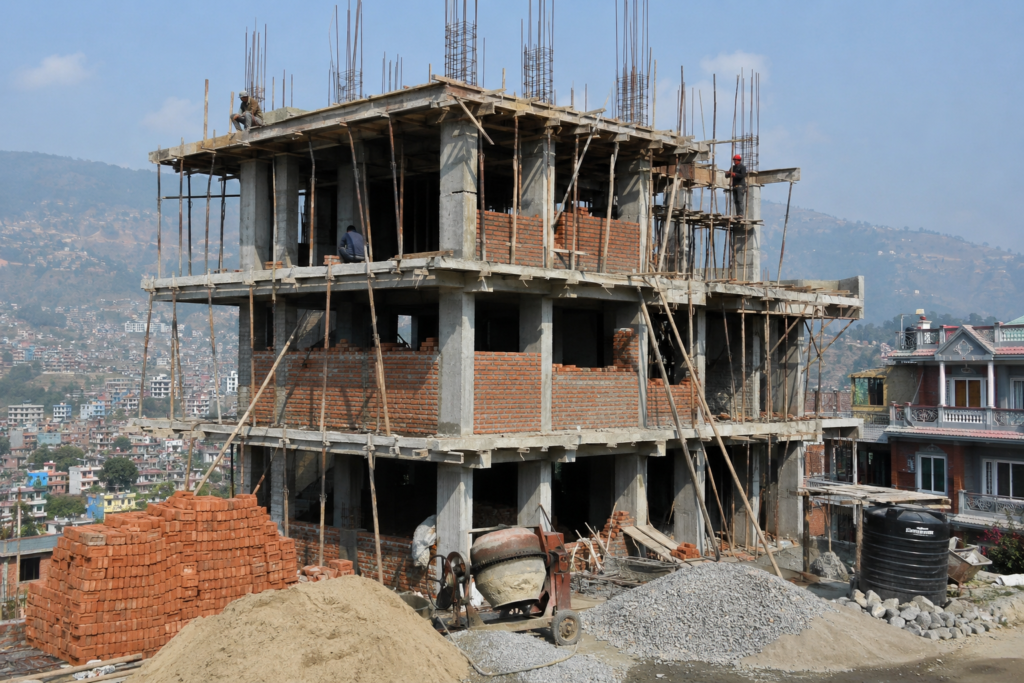
Most people hear “construction cost” and think: walls, columns, slabs, roof. That part is the civil work, and yes, that’s usually what contractors quote you. The problem is that your real cost includes four more layers on top of that.
Electrical and plumbing. Finishing work like tiles, paint, and false ceiling. Fixtures including doors, windows, and sanitary fittings. And site preparation before a single brick gets laid.
A complete cost estimate should cover all of this: structural RCC frame, brickwork, plastering, waterproofing, internal wiring, plumbing rough-in, tile flooring, wall paint, and basic sanitary fixtures. Premium items like a modular kitchen, imported tiles, or an elevator provision sit on top of that base cost. When a contractor gives you a number, always ask whether it covers finishing or only civil. That one question will save you a lot of stress later.
House Construction Cost Per Sq Ft in Nepal 2026
In Nepal, building a house costs between Rs 3,200 and Rs 6,500 per square foot right now. For a standard 1,500 sq ft home in the Kathmandu Valley, your total budget will be somewhere between Rs 48 lakh and Rs 97 lakh. That gap is not random. It depends on your finish level, location, structural requirements, and a few decisions you’ll make early on that most people don’t think about until later.
If you want a ballpark figure fast, our construction cost calculator gives you an estimate based on your plot size and finish preference. But if you want to understand what actually drives that cost up or down, and how to avoid the budget shocks that catch most first-time builders off guard, read through this first.
What Does House Construction Cost Actually Include?
Most people hear “construction cost” and think: walls, columns, slabs, roof. That part is the civil work, and yes, that’s usually what contractors quote you. The problem is that your real cost includes four more layers on top of that.
Electrical and plumbing. Finishing work like tiles, paint, and false ceiling. Fixtures including doors, windows, and sanitary fittings. And site preparation before a single brick gets laid.
A complete cost estimate should cover all of this: structural RCC frame, brickwork, plastering, waterproofing, internal wiring, plumbing rough-in, tile flooring, wall paint, and basic sanitary fixtures. Premium items like a modular kitchen, imported tiles, or an elevator provision sit on top of that base cost. When a contractor gives you a number, always ask whether it covers finishing or only civil. That one question will save you a lot of stress later.
House Construction Cost Per Sq Ft in Nepal 2026
These rates cover both labour and materials, based on current market prices in the Kathmandu Valley.
| Construction Type | Cost per Sq Ft (NPR) | For a 1,500 sq ft home | What’s Included |
|---|---|---|---|
| Economy / basic | Rs 3,200 – 3,800 | Rs 48L – 57L | Local brick, standard cement, basic tiles, no false ceiling |
| Standard / mid-range | Rs 4,000 – 4,800 | Rs 60L – 72L | Good quality brick, MS grills, ceramic tiles, basic modular kitchen |
| Semi-luxury | Rs 5,000 – 5,800 | Rs 75L – 87L | Imported tiles, false ceiling, branded electrical fittings, better sanitary ware |
| Luxury / premium | Rs 6,000 – 6,500+ | Rs 90L – 97L+ | Italian marble, full modular kitchen, elevator provision, smart home wiring |
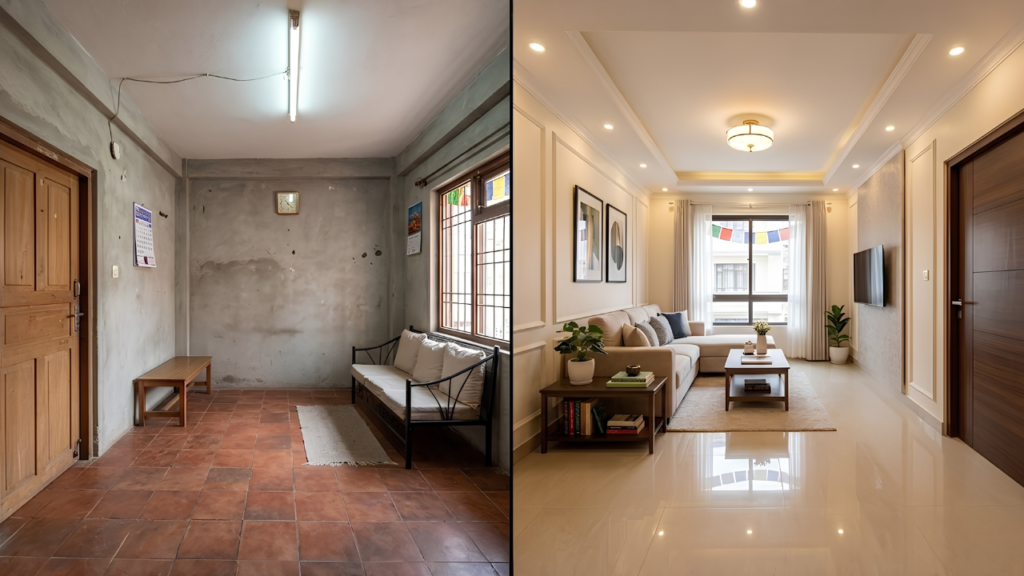
One thing we see in almost every project: clients start with a standard budget and then switch to semi-luxury finishes partway through. That jump adds Rs 15 to 18 lakh to a 1,500 sq ft build. It is not a problem if you plan for it, but if you don’t, it hits hard. Decide your finish level before construction starts and write it into your contract.
Can I Build a House in Nepal Under Rs 3,500 per Sq Ft?
Yes, but only if a few conditions line up.
Rs 3,200 to 3,500 per sq ft is realistic if you are building outside the Kathmandu Ring Road, where labour and transport costs are lower. Bhaktapur, the outskirts of Lalitpur, and satellite towns like Banepa and Dhulikhel all fall into this category. It also requires a simple rectangular footprint with no cantilevers, no curved walls, and no basement. And you need to use locally sourced brick and aggregate rather than materials being transported in.
Add a basement and the calculation changes immediately. Excavation, retaining walls, and waterproofing membrane push the cost of that level up by Rs 600 to 900 per sq ft on its own. Building on a slope adds 15 to 20 percent to your foundation cost.
In our Kirtipur project last year, the client came in with a firm budget of Rs 3,400 per sq ft. Once we added a half-basement for parking and applied proper earthquake-resistant design per NBC 105 standards, the actual civil cost settled at Rs 3,950 per sq ft. That is not a surprise if you factor it in from the start. It is a serious problem if you find out halfway through.
What Is the Best Way to Avoid Budget Overruns?
Three things cause almost every overrun in Nepal construction: scope creep, material price changes, and a contract that is too vague.
Scope creep is the most common one. You decide to add a bathroom, upgrade your tiles, or shift a door after construction has started. Each change costs two to three times what it would have cost in the design phase because workers have to undo finished work first. The fix is simple but requires discipline: finalise your floor plan completely before a single column is cast. Not mostly finalised. Done.
Material prices shift with the monsoon. Sand and aggregate get significantly more expensive from Ashadh through Ashwin because river extraction stops during that period. Steel follows international markets. To handle this, build a 10 to 12 percent contingency into your total estimate from day one and treat it as untouchable unless something genuinely unexpected happens.
The most protective document you can have is a Bill of Quantities, or BOQ. This is a line-by-line breakdown of every material and rate your contractor is committing to. If your contractor gives you a lump-sum quote with no BOQ behind it, that is a serious warning sign. At AS Designs, we provide a full BOQ before any work starts on site. It is the single best protection against invoices that appear out of nowhere.
How to Choose the Right Construction Approach for Your Nepal Home
You have three real options: hire a main contractor, manage sub-contractors yourself through a civil engineer, or go with a design-build firm.
A main contractor is the most common route. You pay a premium of roughly 12 to 18 percent above labour and material cost, but you have a single person accountable for everything. This works well if you are living outside Kathmandu during construction or simply don’t have time to be on site regularly.
Managing sub-contractors yourself through a civil engineer is cheaper. You handle mason contractors, plumbers, electricians, and finishing teams separately. If you are available every day and you understand construction, this approach can save Rs 8 to 12 lakh on a mid-sized build. If you are not available daily, those savings disappear quickly through coordination mistakes and material wastage.
A design-build firm covers everything from architectural drawings and NBC compliance through structural engineering and construction, all under one contract. The cost sits close to a main contractor, but you get integrated design and construction, which usually means fewer errors and delays on site.
For most Kathmandu Valley clients building their first home under 2,500 sq ft, the design-build route is what we recommend. Above that size, getting separate bids for construction can be worth the extra coordination effort.
Common Mistakes Nepalis Make With Construction Budgets
The one almost no one accounts for upfront: external development charges. Kathmandu Metropolitan City applies development tax, road contribution fees, and water connection charges that can add Rs 3 to 6 lakh to your total cost depending on your zone and plot size. No contractor includes these in their quote because they have nothing to do with the contractor’s work.
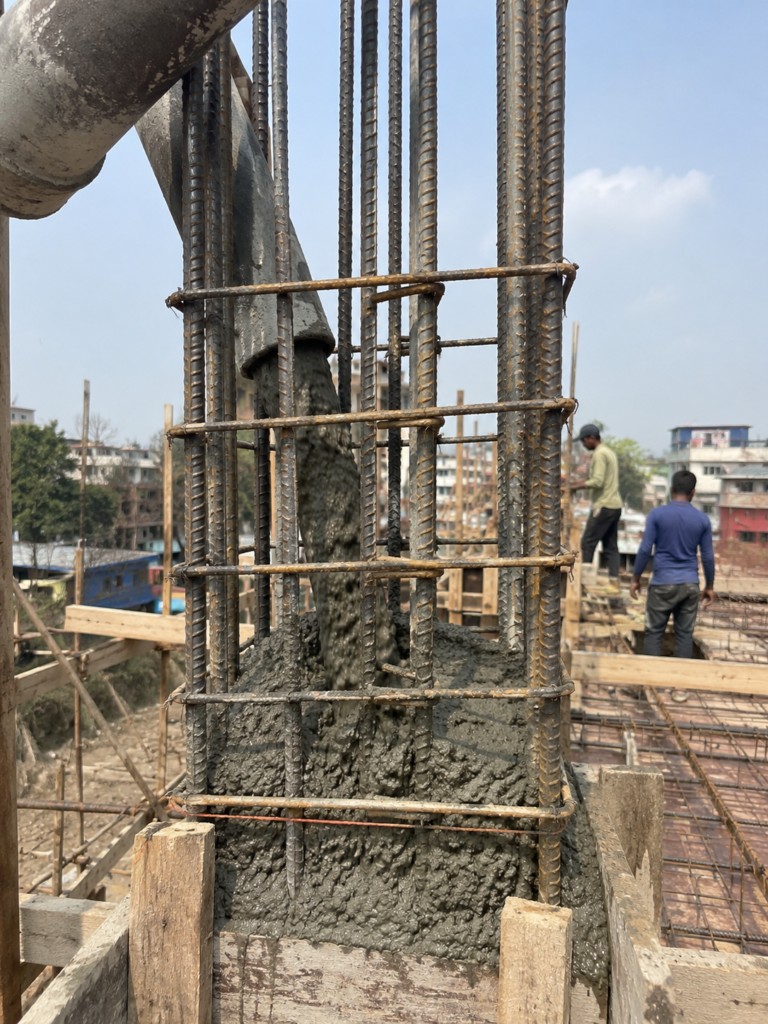
Second mistake: cutting corners on seismic detailing. Nepal sits in Seismic Zone V. NBC 105 and NBC 202 specify column sizes, reinforcement ratios, and connection details that some contractors quietly reduce to save cost. Do not let this happen on your site. Proper seismic design costs roughly Rs 80 to 120 per sq ft extra, which works out to Rs 1.2 to 1.8 lakh on a 1,500 sq ft home. It is one of the few things in construction where the cheapest option is genuinely not worth it.
Third mistake: underestimating how much finishing costs. Civil work is fast and feels like progress. Finishing work, tiles, paint, false ceiling, carpentry, fixtures, takes just as long and often costs 35 to 45 percent of your total build budget. Most first-time builders allocate most of their budget to civil work and then run short at the end.
We saw exactly this in a Baneshwor project recently. The clients had spent their entire budget on civil work by the time finishing started. They hadn’t set aside a separate finishing budget, and they ended up compromising on flooring and kitchen fittings in ways they still mention when we speak to them. Budget for civil and finishing separately from the beginning. They are not the same thing.
For everything beyond cost , choosing a contractor, getting permits, construction timeline, and finishing read our complete guide to building a house in Nepal 2026
FAQ
How much does it cost to build a house in Nepal in 2026?
What is the construction cost per Aana in Nepal?
How long does it take to build a house in Nepal?
Do I need a structural engineer for my house in Nepal?
What is the cheapest way to build a house in Nepal?
Ready to Get an Accurate Cost for Your House?
Planning to build your home in Kathmandu, Lalitpur, Bhaktapur, or surrounding areas? Our AS Designs team offers free initial consultations and detailed cost estimates with full BOQ breakdown no vague lump sums.
Call Us : +977-9860115463 Or WhatsApp us directly → We’re based in Kathmandu and have completed residential projects across the Valley.
Do check our Channels for more :