Is your old kitchen cramped, outdated, and impossible to keep organized? You’re not alone. Thousands of homeowners across Kathmandu, Pokhara, and Lalitpur are discovering what modern modular kitchens can do—not just for aesthetics, but for functionality, resale value, and daily convenience.
But here’s the challenges For Modular Kitchen Design in Nepal: most people dive into modular kitchen projects without understanding costs, materials, or design options specific to Nepal’s market. They end up overpaying, choosing the wrong layout, or settling for low-quality materials that don’t last.
This guide changes that. Whether you’re renovating a small apartment kitchen or designing a spacious cooking area in your new home, you’ll learn everything from pricing breakdowns to layout strategies, material comparisons, and design tips that work specifically for Nepali homes.
What is a Modular Kitchen and Why is it Popular in Nepal?
A modular kitchen consists of pre-manufactured cabinet modules that fit together like building blocks. Unlike traditional carpentry where everything is built on-site, modular units come ready-made in standard sizes—base cabinets, wall units, tall units, and accessories—all designed to maximize storage and workflow efficiency.
Why Nepali homeowners are switching to modular designs:
The trend has exploded in urban areas over the past five years. Families appreciate the clean lines, organized storage, and modern appliances that modular systems accommodate. Beyond looks, these kitchens solve practical problems: limited space in city apartments, the need for termite-resistant materials in humid climates, and the desire for low-maintenance surfaces that handle daily cooking without showing wear.
Modular kitchens also add significant resale value. Real estate agents consistently report that homes with well-designed modern kitchens sell faster and command higher prices—especially in competitive markets like Kathmandu’s core neighborhoods.
Understanding Modular Kitchen Design in Nepal Pricing (Per Sq.Ft Breakdown)
One of the most common questions we hear: “How much does a modular kitchen actually cost?” The answer depends on materials, finishes, hardware quality, and design complexity.
Basic Budget Range (NPR 1,800 – 2,500 per sq.ft): Entry-level modular kitchens use laminate finishes on plywood or particle board. You’ll get functional cabinets with basic hinges and handles, simple countertops, and standard storage solutions. Perfect for rental properties or temporary setups.
Mid-Range Quality (NPR 2,500 – 4,500 per sq.ft): This is where most homeowners land. Mid-range kitchens feature marine plywood or boiling water-resistant plywood, branded laminate finishes, soft-close mechanisms, modular drawer systems, granite or quartz countertops, and integrated lighting. The quality difference is immediately visible and lasts 15-20 years with proper care.
Premium Designs (NPR 4,500 – 8,000+ per sq.ft): High-end modular kitchens incorporate acrylic or lacquered glass shutters, imported hardware from brands like Blum or Hettich, engineered stone countertops, built-in appliances, and custom storage solutions. These kitchens become statement pieces that define the entire home’s aesthetic.
What drives the cost up? Hardware quality makes a dramatic difference. Soft-close hinges cost three times more than standard ones, but they extend cabinet life and create a premium feel. Countertop choices matter too—granite runs NPR 400-800 per sq.ft, while engineered quartz starts at NPR 1,200. Appliances like chimneys, built-in ovens, and dishwashers add NPR 50,000-200,000 to total investment.
For a typical 80-100 sq.ft kitchen (common in Nepali homes), expect total costs between NPR 2,00,000 to 4,50,000 for quality mid-range execution. If you’re planning a kitchen renovation and want to understand your complete construction budget, try our house construction cost estimator tool.
Best Modular Kitchen Layouts for Nepali Homes
Kitchen layout determines workflow efficiency more than any other factor. The wrong layout creates bottlenecks, wasted steps, and frustration during meal prep. Here’s how to choose the right configuration for your space.
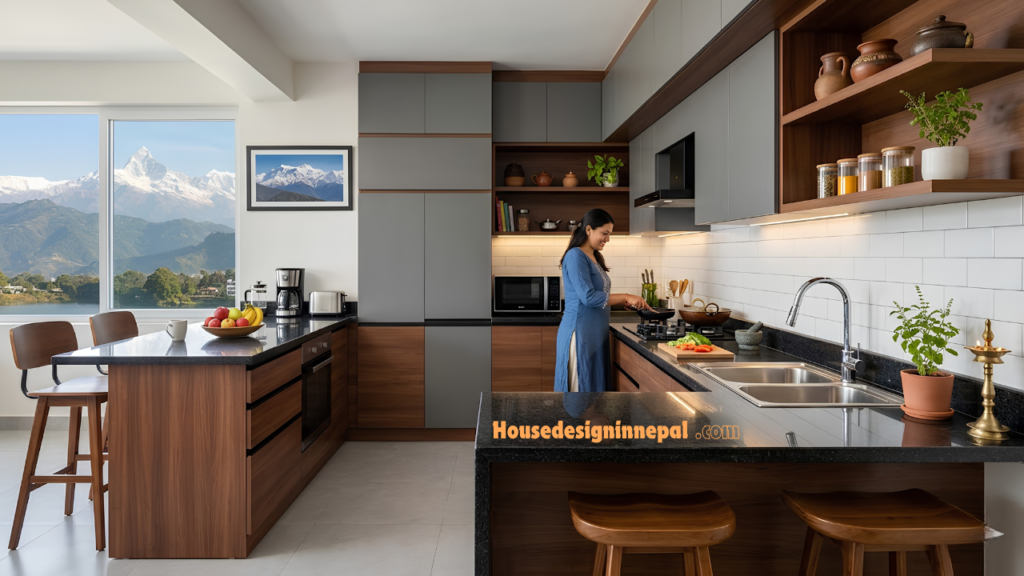
L-Shaped Kitchen Design: The most popular choice for apartments and medium-sized homes. This layout positions cabinets along two perpendicular walls, creating a natural work triangle between the stove, sink, and refrigerator. The open side allows for dining tables or breakfast counters, making it ideal for spaces between 70-120 sq.ft.
L-shaped designs work particularly well in rectangular rooms typical of Nepali construction. You maximize corner space with specialized carousel units or magic corner systems that make corner cabinets fully accessible. Many homeowners add a small island or peninsula if space permits, creating additional prep area and storage.
U-Shaped Kitchen Design: When you have 100+ sq.ft and three available walls, U-shaped layouts provide maximum storage and counter space. This configuration surrounds the cook on three sides, keeping everything within arm’s reach. It’s perfect for serious home cooks who need multiple work zones—one for prep, one for cooking, one for cleanup.
The challenge with U-shaped kitchens in Nepal: they require careful planning to avoid a cramped feeling. Maintain at least 4-5 feet of clearance in the center pathway. Corner cabinets need smart solutions like LeMans units or pull-out systems to stay functional.
Straight/Single-Wall Kitchen: For small apartments or studio spaces with 40-70 sq.ft, a single-wall layout lines up all cabinets and appliances along one wall. While it’s the most space-efficient, workflow efficiency drops because the work triangle collapses into a straight line.
Maximize this layout by using tall cabinets that reach the ceiling, incorporating a breakfast counter if possible, and choosing slide-out storage that brings items forward rather than forcing you to reach back into deep cabinets.
Parallel/Galley Kitchen: Two parallel counters create an efficient corridor kitchen, common in row houses or elongated kitchen spaces. This layout works well for 60-90 sq.ft areas where width is limited but length is available. Keep the corridor at least 4 feet wide for comfortable movement—narrower feels claustrophobic, wider wastes steps.
Want to visualize which layout fits your space best? Our team at HouseDesignInNepal creates 3D kitchen designs that let you walk through your future kitchen before construction begins.
Essential Materials for Modular Kitchens in Nepal

Material choices determine your kitchen’s durability, maintenance needs, and long-term satisfaction. Here’s what actually works in Nepal’s climate and construction practices.
Cabinet Carcass (The Hidden Foundation):
Marine plywood remains the gold standard for cabinet boxes in Nepal. It handles moisture better than particle board or MDF, crucial during monsoon season when humidity levels spike. Look for 18mm marine ply for cabinet bodies and 12mm for shutters. Yes, it costs 30-40% more than particle board, but it lasts twice as long and resists termite damage.
Boiling water-resistant (BWR) plywood offers a middle ground—better moisture resistance than commercial ply, more affordable than full marine grade. Many mid-range kitchens use BWR for wall cabinets and marine ply for base cabinets that face more exposure.
Avoid regular commercial plywood in kitchens. We’ve seen too many kitchens deteriorate within 3-4 years because owners tried to save NPR 20,000 on materials, only to spend NPR 150,000 replacing everything.
Shutter Finishes (What People See):
Laminate finishes dominate the Nepali market for good reason—they’re affordable, available in hundreds of designs, and easy to maintain. Brands like Merino, Greenlam, and Royale offer texture options from solid colors to realistic wood grains. High-pressure laminates (HPL) resist scratches better than standard options.
Acrylic shutters bring that glossy, reflective finish seen in premium kitchens. They’re easier to clean than laminate and create a contemporary aesthetic, but they cost 60-80% more and show fingerprints easily. Consider acrylic for upper cabinets where you touch them less frequently.
Membrane foil shutters offer another alternative—seamless finishes without visible edges, good moisture resistance, and moderate pricing. They work well for modern designs but limit you to solid colors rather than wood textures.
Countertop Materials:
Granite remains the most popular countertop choice in Nepal. It’s heat-resistant, scratch-resistant, relatively affordable (NPR 400-800 per sq.ft), and available locally. Black galaxy and tan brown varieties suit most design schemes. The downside: granite requires annual sealing and can crack if hit hard enough.
Quartz (engineered stone) is gaining popularity among homeowners who want the granite look without the maintenance. It’s non-porous, doesn’t need sealing, and offers consistent patterns. The premium: NPR 1,200-2,000 per sq.ft.
Solid surface materials like Corian create seamless installations with integrated sinks and backsplashes. They’re repairable if damaged but expensive (NPR 2,500+ per sq.ft) and can scratch more easily than stone.
Whatever material you choose, extend your countertop 1-2 inches beyond the cabinet face. This overhang protects cabinet edges from spills and makes cleaning easier.
Hardware That Matters:
Don’t cheap out on hinges and drawer slides. Soft-close mechanisms add NPR 15,000-25,000 to an average kitchen but prevent slamming damage that ruins cabinets over time. Blum and Hettich are premium brands; Ebco and Sleek offer good mid-range options available in Nepal.
Handles and knobs seem minor but dramatically affect daily usability. Test them in showrooms—some look great but feel awkward when your hands are wet or oily. Handleless kitchens with push-to-open mechanisms create ultra-modern aesthetics but cost more and require precise installation.
Smart Storage Solutions for Small Kitchens in Nepal
Most Nepali kitchens face the same challenge: limited square footage with high storage demands. Smart storage design multiplies your usable space without expanding walls.
Vertical Storage Maximization:
Take cabinets all the way to the ceiling. That 1-2 feet of space above standard wall cabinets wastes valuable storage. Use top shelves for items you need less frequently—serving platters, seasonal cookware, bulk purchases. A small stepping stool stores easily and makes this space fully functional.
Tall pantry units (6-7 feet high) concentrate massive storage in a small footprint. Modern pull-out pantry systems bring items forward on multiple shelves, eliminating the black hole problem of deep cabinets where things disappear forever.
Corner Cabinet Solutions:
Corner spaces in L-shaped and U-shaped kitchens typically waste 40-50% of their storage potential. Magic corner systems use pull-out mechanisms that swing shelves into the open, making every inch accessible. Carousel/lazy susan units spin to bring items forward, though they’re less efficient than magic corners.
Diagonal corner cabinets cost less than specialized hardware but reduce storage capacity. Use them when budget constraints matter more than maximum storage.
Drawer-Based Storage:
Replace lower cabinets with deep drawers wherever possible. Drawers provide better access than cabinets with doors—you see everything at once rather than kneeling and reaching into dark spaces. Use drawer dividers to organize utensils, spices, and cooking tools.
Tandem drawer systems create two tiers in a single drawer opening—perfect for storing pots, pans, and lids without stacking them in unstable towers.
Hidden Pull-Outs:
Bottle pull-outs fit in 6-inch gaps between cabinets, creating storage from otherwise wasted space. Spice pull-outs bring your entire spice collection into view. Under-sink pull-outs organize cleaning supplies around plumbing.
Appliance garages hide countertop appliances like toasters, mixers, and rice cookers behind lift-up or sliding doors, keeping counters clear while maintaining easy access.
Open Shelving Balance:
One or two open shelves display attractive dishes, plants, or cookbooks while adding visual interest. Don’t overdo it—too much open storage creates visual clutter and requires constant dusting. Use open shelving as an accent, not the primary storage system.
Check out our modern home design tools to experiment with different storage configurations before finalizing your kitchen plan.
Color Combinations and Design Trends for Modern Kitchens in Nepal
Color choices shape your kitchen’s mood, perceived size, and how well it ages over time. Here’s what’s working in Nepali homes right now.
Two-Tone Cabinet Designs:

Pairing light upper cabinets with darker base cabinets creates visual interest while making spaces feel more open. Popular combinations include white or cream uppers with grey, navy, or wood-tone bases. This approach also hides wear on lower cabinets that face more daily contact.
Another approach: match most cabinets in neutral tones, then create a feature wall with bold color or different material. A deep blue or olive green on the chimney wall becomes your kitchen’s statement piece.
Light Colors for Small Spaces:
White, off-white, and light grey cabinets reflect light, making compact kitchens feel larger and brighter—critical in apartments with limited natural light. These neutrals also provide a timeless backdrop that won’t look dated in five years.
The concern about white cabinets showing dirt? Modern laminates and acrylics clean easily with a damp cloth. Choose textures rather than pure glossy finishes to minimize visible fingerprints.
Wood Tones for Warmth:
Wood-grain laminates or veneer finishes bring natural warmth into contemporary kitchens. Light oak and walnut tones balance modern hardware and appliances with organic texture. They’re particularly effective in open-plan homes where the kitchen flows into living spaces.
Real wood veneer costs 40-50% more than laminate but offers authentic texture and grain patterns. Budget-conscious projects use wood-tone laminate that mimics the look at a fraction of the cost.
Bold Accent Colors:
Deep colors like navy, forest green, or charcoal grey create sophisticated, modern kitchens when used carefully. Keep bold colors on one wall or lower cabinets only, balancing them with neutral tones and light countertops. Too much dark color makes small kitchens feel cave-like.
Bright accent colors—yellow, red, teal—work better as small details through handles, backsplashes, or decor rather than entire cabinet sections. These trend-driven choices look dated quickly.
Backsplash Coordination:
Your backsplash bridges cabinets and countertops visually. Subway tiles remain popular—they’re affordable, timeless, and available in countless colors. Glass backsplashes create seamless, easy-to-clean surfaces perfect behind stoves. Patterned tiles add personality but risk feeling busy if you’ve already used multiple cabinet colors.
Match your backsplash to either your countertop or cabinet color, not both. This creates visual hierarchy rather than everything blending together.
Integrating Appliances: Chimney, Sink, and More
Modern modular kitchens aren’t complete without appliances that enhance functionality and maintain air quality. Here’s what to consider for Nepal’s cooking styles.
Kitchen Chimneys:
Chimneys aren’t optional extras—they’re essential for removing smoke, odors, and grease from daily cooking. Nepali cooking, with its tadka preparations and frequent oil use, generates more smoke than Western cooking styles. A quality chimney protects your cabinets and walls from grease buildup that’s nearly impossible to remove.
Choose chimney size based on stove width—60cm chimneys for 3-burner stoves, 90cm for 4-burner ranges. Suction capacity (measured in cubic meters per hour) should be at least 10 times your kitchen volume for effective ventilation. For a 10×10 foot kitchen with 9-foot ceilings, you need minimum 800 m³/hr capacity.
Baffle filter chimneys work better than cassette filters for heavy Indian cooking—they’re more efficient, easier to clean, and last longer. Auto-clean features add NPR 5,000-10,000 but save hours of manual cleaning. Brands like Faber, Elica, and Kaff offer reliable models priced NPR 15,000-45,000.
Sink Selection:
Stainless steel sinks dominate because they’re affordable, durable, and match most design schemes. Choose 18-20 gauge thickness—thinner steel dents easily and sounds louder during use. Underslung installation (sink mounted under granite) creates seamless countertops that wipe clean easily, though it costs NPR 2,000-3,000 more than top-mount.
Granite composite sinks resist scratches and stains better than steel while dampening noise. They cost 2-3 times more but suit premium kitchens where aesthetics matter.
Single-bowl sinks work fine for most homes. Double bowls sound practical but one side often becomes unusable storage. If you have space and budget, a main sink plus a small prep sink offers more flexibility.
Water Purifier Integration:
Built-in water purifiers or under-sink RO systems keep counters clear while providing clean water. Allocate cabinet space (usually under the sink) with plumbing access. Ensure your modular kitchen design includes electrical outlets in appropriate locations—nothing looks worse than exposed wires running across your new backsplash.
Cooktop Considerations:
Gas cooktops remain standard in Nepal, but induction cooktops are gaining ground for their efficiency, safety, and easy cleaning. If you’re considering induction, verify your home has adequate electrical capacity—most induction systems need 20-25 amp circuits.
Built-in ovens, dishwashers, and microwaves require precise cabinet dimensions and proper ventilation. Plan these before cabinet fabrication begins, not as afterthoughts.
Construction Timeline and Process
Understanding the modular kitchen installation process helps you plan around disruptions and coordinate with other renovation work.
Initial Design and Approval (1-2 weeks):
Professional designers visit your site, take measurements, discuss your cooking habits, storage needs, and aesthetic preferences. They create 2D layouts and 3D visualizations showing exactly what your kitchen will look like. This stage includes material selection, color choices, and hardware decisions.
Expect 2-3 revision rounds to fine-tune details. Rush this stage and you’ll regret missing opportunities for better storage or workflow.
Manufacturing Time (3-4 weeks):
Once you approve designs and make the advance payment (typically 40-50%), manufacturers fabricate your cabinet modules. Quality makers won’t rush this process—proper seasoning, precise cutting, and careful assembly take time. Be wary of anyone promising installation in less than three weeks from order to completion.
Site Preparation (2-3 days):
Before installation, complete all plumbing, electrical work, and wall finishes. Your kitchen should have final paint, tiles, and lighting. Trying to do this after cabinet installation creates delays, dust, and potential damage to new cabinets.
Installation (3-5 days):
Skilled installers assemble cabinets, level everything precisely, install countertops, and integrate appliances. Wall cabinets go up first, followed by base cabinets, then countertops and backsplashes. Countertop installation often requires templating (measuring installed cabinets before cutting stone), adding 1-2 days for fabrication.
Final Touches (1-2 days):
Handle installation, internal fittings, drawer organizers, and final adjustments complete the project. Professional installers test every door, drawer, and mechanism before handing over.
Total timeline: 6-8 weeks from initial design to completed kitchen. Trying to compress this significantly usually compromises quality.
If you’re renovating your entire home and need to coordinate kitchen work with other construction, our kitchen interior services in Nepal handle project management so everything flows smoothly.
Common Mistakes to Avoid
Learn from what others get wrong so you don’t waste money fixing preventable problems.
Inadequate Ventilation Planning:
Positioning your stove without proper chimney exhaust creates a lifetime of frustration. Chimneys need exhaust ducts to outside walls or ceilings—not recirculation filters that just push greasy air back into your kitchen. Plan exhaust routes before cabinet fabrication.
Ignoring the Work Triangle:
The imaginary triangle between your stove, sink, and refrigerator determines kitchen efficiency. Ideally, the three points total 12-26 feet. Too small feels cramped; too large wastes steps. Don’t place the refrigerator across the room from prep areas just because that wall had space.
Insufficient Electrical Outlets:
Modern kitchens need more outlets than you think—countertop appliances, under-cabinet lighting, chimney, water purifier, phone charging, and future appliances you haven’t bought yet. Install outlets every 4 feet along countertops, plus dedicated circuits for major appliances.
Choosing Style Over Function:
That gorgeous handleless cabinet design loses appeal when you have wet hands and can’t grip the push-open mechanism. Glass-front cabinets look beautiful but require keeping contents perpetually organized. Balance aesthetics with daily usability.
Cheap Hardware False Economy:
Saving NPR 15,000 on budget hinges and slides means replacing the entire kitchen 5 years earlier. Quality hardware costs 20-30% more upfront but doubles your kitchen’s lifespan. This is the wrong place to cut costs.
Poor Lighting Design:
One ceiling light isn’t enough. Kitchens need task lighting under wall cabinets (so you’re not working in your own shadow), accent lighting inside glass cabinets, and general ambient lighting. LED strip lights under cabinets cost NPR 8,000-15,000 and transform functionality.
Not Planning for Future Needs:
That perfect kitchen for two might feel cramped if your family grows. Consider leaving room for an island later, or designing drawer systems that adapt as needs change. Building flexibility into your initial plan costs less than remodeling in three years.
Working with Professional Kitchen Designers in Nepal
While YouTube tutorials and Pinterest inspiration have their place, professional kitchen design delivers results that DIY approaches can’t match—especially in Nepal’s unique construction context.
What Professional Designers Provide:
Experienced designers understand space optimization techniques that multiply storage without expanding footprints. They know which local suppliers offer the best quality materials at fair prices. They’ve seen common problems in Nepali construction and design around them. They create detailed technical drawings that carpenters and installers can execute accurately.
Most importantly, they prevent expensive mistakes. That NPR 30,000-50,000 design fee saves you from NPR 200,000 worth of problems caused by wrong measurements, poor material choices, or workflow errors you didn’t anticipate.
Questions to Ask Potential Designers:
How many modular kitchens have you completed in the past two years? (Look for at least 10-15 projects.) Can I visit completed projects or see detailed portfolios? What brands do you work with for materials and hardware? Do you provide 3D visualizations before fabrication? What’s included in your design fee versus what costs extra?
Ask about their installation team—are they employees or subcontractors? How do they handle problems that arise during installation? What kind of warranty or post-installation support do they offer?
Design Fees in Nepal:
Expect to pay NPR 25,000-75,000 for professional modular kitchen design, depending on kitchen size and complexity. Some fabricators include basic design free with their installation package, but you get what you pay for—free design often means generic layouts without customization for your specific needs.
The best approach: hire an independent designer who isn’t tied to a specific manufacturer. They’ll create layouts optimized for your space, then help you choose from multiple fabricators to find the best quality-to-price ratio.
Installation Quality Matters:
Beautiful design means nothing if installation is sloppy. Cabinets must be perfectly level—even 1-2mm off causes doors to swing open and creates gaps. Countertop joints should be nearly invisible. Hardware should operate smoothly from day one.
Quality installers take time, use proper tools, and don’t cut corners. They cost 15-20% more than bargain installers but deliver kitchens that function perfectly for 15-20 years.
For professional modular kitchen design services that handle everything from concept to installation, connect with specialists who understand Nepal’s unique construction environment—check out portfolios from local design studios to see completed projects and client reviews.
Budgeting and Financing Your Modular Kitchen
Let’s talk numbers honestly. Most families investing in modular kitchens need to balance quality aspirations with financial reality.
Creating a Realistic Budget:
Start with your available funds, not your dream kitchen. A realistic mid-range modular kitchen for 80-100 sq.ft in Nepal costs NPR 2,50,000-4,00,000 including materials, installation, appliances, and contingency. Breaking this down:
- Cabinets and countertops: 55-60% of budget
- Appliances (chimney, sink, faucet): 15-20%
- Installation and labor: 12-15%
- Electrical and plumbing work: 8-10%
- Contingency for changes: 5-8%
Where to Splurge vs. Save:
Spend more on: Cabinet structure (marine plywood), hardware (hinges and slides), countertops, and professional installation. These determine longevity and daily functionality.
Save on: Shutter finishes (laminate vs. acrylic), decorative handles, and some appliances. You can use quality laminate instead of acrylic and achieve 90% of the look at 60% of the cost.
Financing Options:
If you’re building or renovating your entire home, include kitchen costs in your home loan—interest rates are lower and repayment timelines longer. Some banks offer home improvement loans specifically for renovation projects with interest rates 2-3% higher than primary home loans.
Credit cards with EMI conversion let you spread costs over 6-12 months, though interest rates run higher. Some kitchen manufacturers offer installment plans—typically 30-40% advance, 30% during installation, balance on completion.
Use our EMI calculator for home renovation to understand monthly payment implications before committing to a budget.
Getting Multiple Quotes:
Never accept the first quote you receive. Get detailed proposals from at least three different suppliers. Make sure quotes itemize materials, hardware brands, countertop specifics, appliances, and what’s included versus optional extras.
Watch for hidden costs: some quotes exclude electrical work, plumbing modifications, or installation charges. Others include everything but use inferior materials. Compare line-by-line, not just total numbers.
Maintenance and Long-Term Care
Your modular kitchen represents significant investment. Proper maintenance preserves that investment and keeps everything functioning smoothly for decades.
Daily and Weekly Care:
Wipe cabinets with a dry or slightly damp cloth after cooking to remove grease buildup. Don’t use harsh chemical cleaners on laminate—they dull the finish. For stubborn stains, mild dish soap and water work fine.
Clean chimney filters every two weeks if you cook daily. Pop baffle filters in the dishwasher or soak in hot water with degreaser. This simple task maintains suction efficiency and prevents grease from spreading to cabinets.
Granite countertops need quick cleanup of spills, especially acidic substances like lemon juice or vinegar that can etch the surface. Wipe up immediately, then clean with neutral pH cleaner.
Monthly and Seasonal Tasks:
Check and tighten all hardware—handles, hinges, and drawer slides—every few months. Normal use gradually loosens screws. Five minutes with a screwdriver prevents bigger problems.
During monsoon season, keep cabinet doors open occasionally to allow air circulation, preventing moisture buildup that damages even marine plywood over time. Run your chimney on high for a few minutes weekly even if you’re not cooking to prevent motor seizing.
Annual Maintenance:
Reseal granite countertops once yearly. Water should bead up on sealed granite; if it soaks in, apply fresh sealant. Most hardware stores carry granite sealers for NPR 800-1,500.
Inspect drawer slides and hinges for wear. If doors or drawers aren’t closing smoothly, adjustment or replacement prevents further damage to cabinet structures.
Deep clean your entire chimney system annually, including internal ducts if accessible. Professional cleaning services charge NPR 2,000-4,000 but dramatically improve efficiency and reduce fire risk.
Addressing Problems Early:
Water leaks from sinks or plumbing destroy cabinets fast. At the first sign of moisture under sinks, locate and fix leaks immediately. Replace damaged cabinet sections before rot spreads.
Loose hinges or misaligned doors seem minor but cause daily frustration. Don’t live with malfunctioning hardware—repairs take minutes and prevent bigger damage from doors that don’t close properly.
Why Choose HouseDesignInNepal for Your Modular Kitchen?
After working through all these details, you might feel overwhelmed. That’s exactly why working with experienced professionals makes sense.
At HouseDesignInNepal, we’ve designed and installed over 150 modular kitchens across Kathmandu Valley and beyond. We understand Nepal’s construction practices, material availability, price points, and what actually works in local homes—not just what looks good in international magazines.
Our Complete Process:
We start with understanding how you actually use your kitchen—not just what it should look like. Do you cook elaborate meals daily or mostly simple dishes? Do multiple people cook simultaneously? What storage frustrates you most about your current kitchen?
From there, we create detailed 3D visualizations that show exactly what your kitchen will look like from every angle. You’ll see cabinet colors, countertop materials, lighting effects, and how everything fits your space before we fabricate a single piece.
We source materials directly from reliable suppliers, eliminating middleman markup while maintaining quality standards. Our installation teams have years of experience—they’re employees, not random subcontractors—and we stand behind their work.
Beyond Just Kitchens:
If you’re planning comprehensive home renovation or new construction, we handle complete home improvement services in Nepal—from architectural design to interior execution. Your kitchen design integrates seamlessly with overall home aesthetics and functionality.
Want to see our recent work? Check out our Instagram portfolio for completed projects, client testimonials, and design inspiration specifically for Nepali homes. You can also explore before-and-after transformations on our YouTube channel.
Take the Next Step Toward Your Dream Kitchen
You now understand what makes modular kitchens work in Nepal—from materials and pricing to layouts and long-term care. The information in this guide represents years of experience and hundreds of successful installations.
But reading about kitchens isn’t the same as cooking in one that’s perfectly designed for your family. The next step is simple: let’s talk about your specific space, budget, and vision.
Book a free modular kitchen design consultation today. We’ll visit your site, discuss your needs, and create a preliminary concept at no charge. There’s no obligation—just an opportunity to see what’s possible with your space and budget.
Get your custom kitchen 3D design + budget estimate now. Within a week of our consultation, you’ll have detailed visualizations, material specifications, and exact pricing. This lets you make informed decisions with complete transparency.
Check modular kitchen pricing and materials before you start. Not ready for a full consultation? Use our tools to estimate costs, explore design options, and plan your budget. Visit our resource page for calculators, material comparators, and planning guides.
Transform your old kitchen into a modern modular kitchen — contact us now. Whether you’re renovating an existing space or designing a kitchen for new construction, we’ll guide you through every decision and deliver a kitchen that exceeds expectations.
For more inspiration and detailed technical resources on interior design and space planning, explore industry insights that help you understand what’s possible in modern Nepali home design.
Ready to get started? Contact HouseDesignInNepal today and let’s create a kitchen that combines beauty, functionality, and lasting quality—designed specifically for how you live and cook.