By House Design in Nepal | Last updated: 2026 | Reading time: 12 min
All prices in Nepali Rupees (NPR). Based on 2025–2026 Kathmandu Valley market rates. Pokhara: 5–10% lower. Terai cities: 8–15% lower.
If you’re planning a home interior in Nepal and wondering how much it actually costs — not a vague “it depends” answer, but real numbers you can take to a contractor — this guide is for you.
We’ve broken down every room, every tier, and every line item. Whether you’re building a first home in Budhanilkantha or finishing a luxury penthouse in Jhamsikhel, the numbers here reflect what Nepali homeowners are actually spending in 2025.
The Three Tiers of Home Interior in Nepal
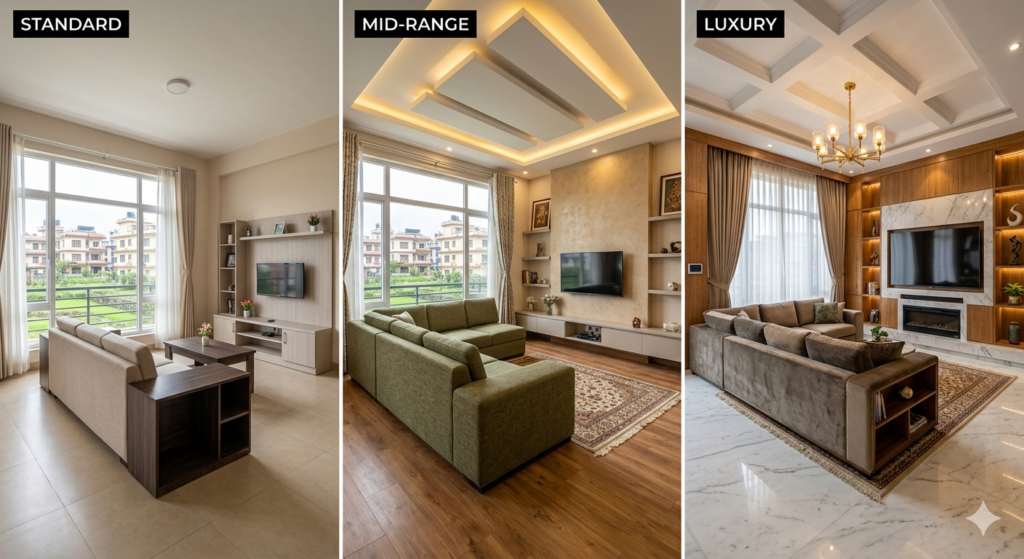
Before the numbers, understand what each tier means in the Nepal market:
Standard (NPR 48–52 lakhs for a complete home) Local materials, quality brands at entry level, clean finishes. Sheesham wood furniture, ceramic tiles, laminate wardrobes, LG or Samsung entry-range appliances. This is the tier most first-time homeowners in Kathmandu build at. It looks good. It lasts. It is not cheap — it just isn’t luxury.
Mid-Range (NPR 1–1.1 crore for a complete home) A mix of local craftsmanship and imported fittings. Engineered wood flooring, Jaquar or Hindware bathroom fixtures, Hettich soft-close hardware, quartz countertops. This is where design-conscious families land — the space feels intentional, not just furnished.
Luxury (NPR 2–2.3 crore for a complete home) Imported everything. Kohler bathrooms, Daikin inverter ACs, Hafele kitchen fittings, marble flooring, motorised curtains, Sony/Samsung premium TVs. Natural stone, Corian, custom carpentry throughout. If you’re asking whether you can afford this tier, you probably want mid-range.
Full Budget Breakdown — All Rooms
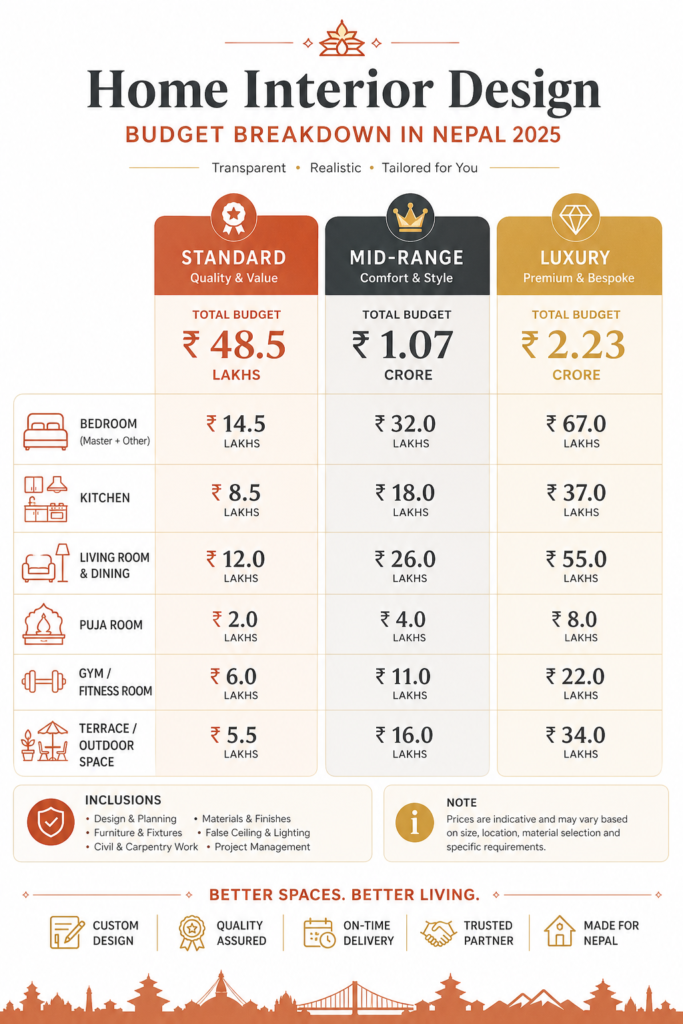
This table covers a complete home: master bedroom with ensuite, living room, kitchen, puja room, laundry, home bar, terrace, store room, pantry, and home gym. Plus flooring, false ceiling, wall texture and all electrical work.
| Room / Area | Standard (NPR) | Mid-Range (NPR) | Luxury (NPR) |
|---|---|---|---|
| Master Bedroom + Ensuite Bathroom | 9,70,000 | 21,07,000 | 43,04,000 |
| Living Room | 6,14,000 | 12,45,000 | 25,82,000 |
| Kitchen | 4,29,000 | 10,25,000 | 21,93,000 |
| Puja Room / Mandir | 1,17,000 | 3,62,000 | 9,42,000 |
| Laundry Room | 1,84,000 | 3,43,000 | 5,99,000 |
| Home Bar | 1,78,000 | 3,76,000 | 7,85,000 |
| Terrace | 2,44,000 | 5,41,000 | 11,63,000 |
| Store Room | 51,000 | 1,05,000 | 1,98,000 |
| Pantry (Walk-in) | 88,000 | 1,86,000 | 3,80,000 |
| Home Gym | 3,72,000 | 8,28,000 | 17,35,000 |
| Flooring — all rooms | 2,50,000 | 5,80,000 | 12,00,000 |
| False Ceiling — all rooms | 1,20,000 | 2,60,000 | 5,50,000 |
| Wall Texture — all rooms | 80,000 | 2,00,000 | 4,50,000 |
| Electrical / Sockets — all rooms | 1,20,000 | 2,50,000 | 5,00,000 |
| Subtotal | 38,17,000 | 84,08,000 | 1,75,81,000 |
| + 15% Contingency | 5,73,000 | 12,61,000 | 26,37,000 |
| + 12% Designer Fee | 4,58,000 | 10,09,000 | 21,10,000 |
| Grand Total | ~NPR 48.5 lakhs | ~NPR 1.07 crore | ~NPR 2.23 crore |
| Approx. USD | ~$36,000 | ~$80,000 | ~$168,000 |
Real Case Study: A Kathmandu Family’s Mid-Range Build (2024)
Ramesh and Sunita Shrestha finished furnishing their 3BHK flat in Lazimpat in late 2024. Their brief: modern Nepali aesthetic, nothing that looks “Indian flat,” proper storage, and a puja room their parents would approve of.
They went mid-range on most rooms and standard on the laundry, store room and pantry.
Their final spend:
- Master bedroom + ensuite: NPR 18.5 lakhs
- Living room: NPR 11 lakhs
- Kitchen: NPR 9.5 lakhs (modular, Hettich fittings, quartz top)
- Puja room: NPR 3.2 lakhs (sheesham mandir, marble floor, Newari carved arch from Patan)
- Laundry + store room: NPR 2.8 lakhs (standard)
- Flooring, ceiling, texture: NPR 9 lakhs
- Electrical: NPR 2.2 lakhs
- Total before contingency: NPR 56.2 lakhs
- Contingency used (12%): NPR 6.7 lakhs (chimney import delay from India added 3 weeks and cost NPR 18,000 extra; wardrobe carpenter rework added NPR 45,000)
- Designer fee (10%): NPR 5.6 lakhs
- Grand total: NPR 68.5 lakhs
“We thought we’d spend NPR 50 lakhs. We spent NPR 68 lakhs. The contingency wasn’t wasted — we used almost all of it. The designer fee absolutely saved us money. She found us the Patan craftsman, negotiated the chimney replacement and stopped us from buying a sofa we would have regretted.” — Sunita Shrestha, Lazimpat, Kathmandu
What the Standard Package Actually Gets You
A lot of homeowners look at “NPR 48.5 lakhs” and assume it means compromise. It doesn’t. Here’s what standard-tier buys you in real terms:
Master bedroom: King-size bed with hydraulic storage base, his-and-her bedside tables, a full wardrobe with sliding mirror doors, 1.5 ton inverter AC, 55″ 4K Smart TV, blackout curtains, and a proper ensuite with a frameless shower enclosure, double basin vanity, and wall-hung commode.
Kitchen: Full modular L-shape layout in marine ply with laminate shutters, quartz countertop, 4-burner gas hob with chimney, 350L frost-free fridge, built-in microwave, and under-sink RO water purifier.
Living room: L-shape modular sofa in washable covers, ottomans, 65″ 4K Smart TV on a full-height built-in TV unit, false ceiling with cove LED lighting, large-format vitrified tile flooring, and one feature wall.
This is a comfortable, modern home. It is not a show flat. If you want the show flat, budget mid-range.
What the Mid-Range Package Adds
The jump from NPR 48.5 lakhs to NPR 1.07 crore is not just “nicer things.” It is a fundamentally different standard of finish:
- Engineered wood flooring instead of vitrified tile in bedrooms and living room — warmer, quieter, holds resale value better
- Jaquar or Hindware bathroom fixtures instead of Parryware — better pressure performance, longer warranty
- Hettich soft-close hardware throughout kitchen — every drawer closes with a whisper
- Venetian plaster on the living room sofa wall instead of sand texture paint
- Motorised curtain tracks in the master bedroom
- Corian or marble in the puja room instead of sheesham
The quality of the experience — opening a drawer, turning a tap, walking barefoot on the floor — is noticeably different. If you spend significant time at home, the mid-range tier pays for itself in daily satisfaction.
The 15% Contingency — Why It Always Gets Used in Nepal
Every experienced interior designer in Kathmandu will tell you the same thing: plan for 15% over your budget. Here is why this is not a cushion — it is a near-certainty:
Import delays. Most quality fittings — Hafele, Hettich, Jaquar, Daikin, RAK Ceramics — arrive from India. Border delays, customs processing, and festival shutdowns routinely push delivery by 3–8 weeks. When the chimney arrives 6 weeks late, your tiler can’t finish the kitchen. That delay costs money.
Material price movement. Between the time you get a quote and the time materials are purchased (often 4–8 weeks later), prices move. Steel, ply and tiles are particularly volatile in Nepal’s import-dependent market.
Rework. On most projects, something needs to be redone. A wardrobe measured incorrectly, a tiler who didn’t maintain slope, a socket in the wrong position. A 15% buffer handles this without derailing the project.
Festival shutdowns. Dashain, Tihar, Chhath — large portions of the Nepali construction calendar simply pause. If your project spans a major festival, add buffer time and cost.
The Shrestha family above used 12% of their contingency. That is typical. Projects that use none are rare. Projects that blow past 15% usually had a major scope change mid-project (adding a home bar, upgrading the puja room marble).
Is the 12% Designer Fee Worth It?
Short answer: yes, almost always.
A good interior designer in Kathmandu does not just make things look nice. They manage procurement — which in Nepal’s fragmented supplier market is a significant skill. They know which timber yard in Teku has the best sheesham stock this season, which tile importer in Pulchowk has RAK Ceramics in the sizes you need, and which carpenters in Bhaktapur do honest work at a fair price.
The Shrestha family’s designer saved them approximately NPR 3.2 lakhs in procurement — by sourcing the puja room marble directly from a Hetauda supplier rather than through a Kathmandu middleman, and by negotiating the kitchen chimney replacement (a manufacturer defect) at no cost to the client. Her fee was NPR 5.6 lakhs. Net saving to the client from her involvement: probably NPR 2–3 lakhs, plus the value of avoiding three major mistakes.
Designer fees in Kathmandu typically run 10–15% of total project cost. Some charge a flat fee for smaller projects. Always ask what the fee covers — good designers include site visits, contractor coordination, and procurement support. Budget designers take the fee and send you a mood board.
Costs by City — Nepal Regional Adjustment
| City / Region | Adjustment vs Kathmandu |
|---|---|
| Kathmandu Valley (all areas) | Baseline |
| Pokhara | 5–10% lower |
| Butwal / Bhairahawa | 8–12% lower |
| Birgunj / Biratnagar (Terai) | 10–15% lower |
| Remote hill districts | 15–25% higher (transport cost) |
Labour is cheaper outside the Valley. Materials are often cheaper too — especially local stone and timber. However, skilled tradespeople (good tilers, experienced carpenters, licensed electricians) are harder to find outside Kathmandu, which can offset the savings.
Key Rules Before You Start
Plan all conduits before plastering. Every electrical socket, TV point, LAN port, AC pipe, and plumbing line must be decided — and the conduit laid — before the walls are plastered. Retrofitting after plastering means breaking walls. It costs 3–5x more and damages your finish. This is the single most expensive mistake Nepali homeowners make.
Insist on RCD/ELCB protection in bathrooms and kitchens. Nepal’s electrical infrastructure is variable. Ground fault protection in wet areas is not optional — it is a safety requirement. Any electrician who resists this should be replaced.
Bolt heavy furniture to structural walls. Nepal is in a high seismic zone. Wardrobes, storage walls, and overhead cabinets must be bolted to the structural wall — not to drywall or partition. This is a safety requirement, not an aesthetic preference.
Use calcium silicate board in bathroom ceilings. Gypsum board warps and grows mould in steam environments. Calcium silicate is moisture-resistant and mandatory in all wet areas. Any contractor who uses gypsum in a bathroom ceiling is cutting costs at your expense.
Frequently Asked Questions
How much does a complete interior design cost in Nepal in 2025?
A complete 3BHK interior typically takes 4–6 months in Kathmandu. Import delays, festival shutdowns, and monsoon weather are the main causes of overrun. The most important time-saving step is deciding all conduit and socket positions before plastering begins.
Is NPR 50 lakhs enough for a full interior in Kathmandu?
Yes, NPR 48–52 lakhs covers a complete standard-tier interior: all rooms furnished and finished, modular kitchen, master bedroom with ensuite, living room, puja room, and a basic terrace. It does not include luxury materials or imported fittings.
How long does an interior design project take in Nepal?
A complete 3BHK interior typically takes 4–6 months in Kathmandu. Import delays, festival shutdowns, and monsoon weather are the main causes of overrun. The most important time-saving step is deciding all conduit and socket positions before plastering begins.
What is cheaper — Kathmandu or Pokhara for interior work?
Pokhara is typically 5–10% cheaper for interior work. Labour costs are lower and some local materials (stone, timber) are more readily available. However, specialist tradespeople and imported fittings availability can be more limited.
Do I need to hire an interior designer in Nepal?
It is not mandatory, but for projects above NPR 30 lakhs it is strongly recommended. A good designer typically saves more than their fee (10–15% of project cost) through procurement, mistake prevention, and contractor management.
What is the most expensive room to design in a Nepali home?
The master bedroom with ensuite bathroom is typically the highest-cost single space — NPR 9.7 lakhs to NPR 43 lakhs depending on tier. The kitchen is the second highest, largely due to appliance cost and modular cabinet system.
Why are interior costs higher in Kathmandu than other cities?
Labour rates are higher in the Valley, skilled tradespeople charge more, transport and logistics cost more, and Kathmandu consumers demand higher-finish materials. Most imported fittings also enter Nepal through Kathmandu, adding a distribution margin.
What to Read Next
- How much does a master bedroom interior cost in Nepal? — Full breakdown of Nepal’s most complex room
- Modular kitchen cost in Nepal — local carpenter vs modular system — The decision most Kathmandu homeowners get wrong
- Puja room and mandir design guide Nepal — Vastu rules, materials, and Newari craftsmanship
- Interior materials and finishes guide Nepal — What to use, where, and why
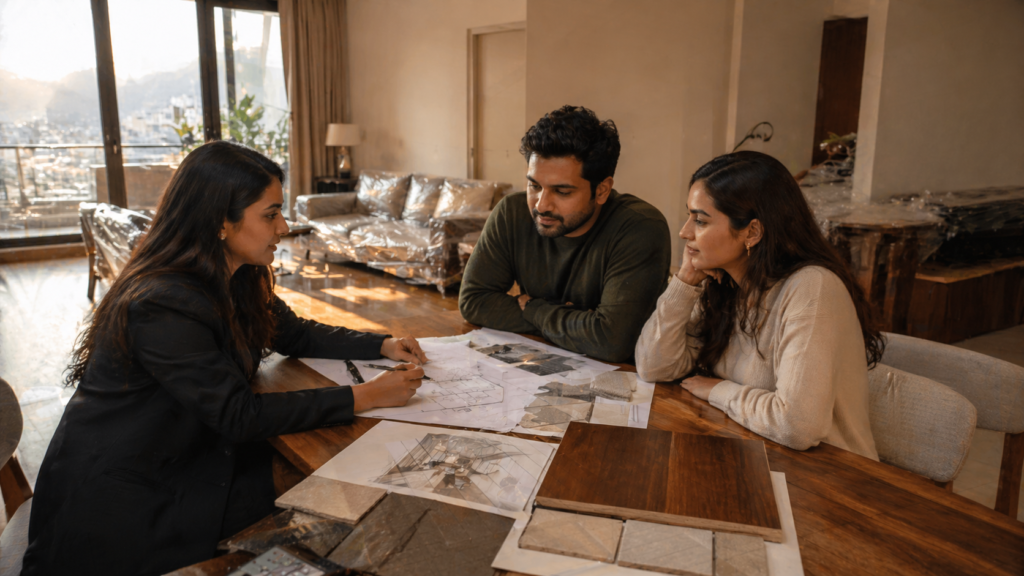
House Design in Nepal is a Kathmandu-based interior design company. For a free site consultation and custom budget estimate, contact us at : Whatsapp AS Design