Per Sq Ft Construction Cost in Nepal

Per Sq Ft Construction Cost in Nepal: 2026 Complete Guide

Planning to build your dream home in Nepal? One of the first questions you’ll ask is: How much will it cost per square foot? It’s a simple question, but the answer isn’t always straightforward. Construction costs vary wildly depending on where you’re building, what materials you choose, and how complex your design is.

Without clear, localized information, budgeting for a home can feel like guesswork. You might get quotes from contractors that differ by thousands of rupees, leaving you confused about what’s fair and what’s inflated. That’s why understanding the real per sq ft construction cost in Nepal is crucial before you break ground.

This guide breaks down actual costs, explains what affects pricing, and gives you practical tools to plan smartly. Whether you’re building a budget-friendly home or a premium villa, we’ll help you understand exactly where your money goes. And if you need instant estimates, our House Construction Cost Calculator Nepal can give you a ballpark figure in minutes.

Let’s dive into the real numbers.

What is Per Sq Ft Construction Cost? (And Why It Matters)

Breaking Down the Concept

When contractors talk about “per sq ft construction cost,” they’re referring to the total expense of building divided by the total built-up area. It’s a simple metric that helps you compare different projects, quotes, and construction types at a glance.

Here’s what’s typically included in per sq ft cost:

  • Structural work: foundation, columns, beams, slabs (the RCC framework)
  • Masonry: brick or block walls
  • Plastering and finishing: both interior and exterior
  • Basic flooring: tiles or cement
  • Painting: standard quality
  • Doors and windows: basic wooden or aluminum
  • Electrical and plumbing: basic fixtures and fittings

What’s NOT usually included:

  • Land purchase cost
  • Architect and engineer fees
  • Government permits and approvals
  • Furniture and appliances
  • Landscaping and compound walls
  • Advanced features like solar panels or home automation

Understanding this breakdown helps you ask the right questions when getting quotes. A contractor offering NPR 2,000 per sq ft might seem cheap, but if they’re excluding plastering or electrical work, you could end up paying much more than expected.

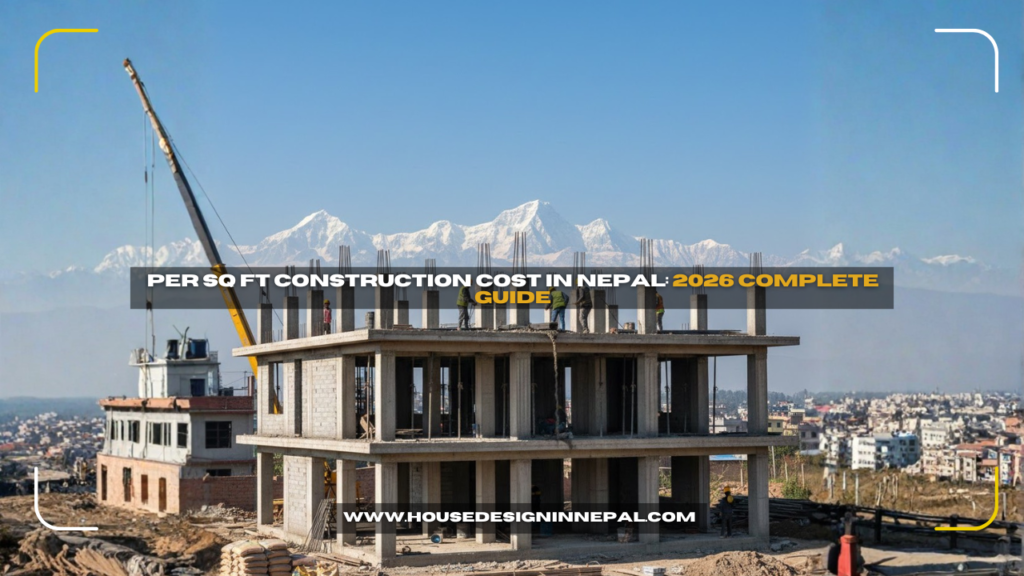
RCC Construction Phase

Why Costs Vary So Much in Nepal

Nepal’s diverse geography and varying levels of development mean construction costs can swing dramatically. A home in Kathmandu might cost 20% more than an identical house in Butwal, simply because of location factors.

Here’s why costs vary:

Location matters more than you think. Building in Kathmandu Valley means higher labor costs, more expensive land, and increased material transportation expenses. In contrast, building in smaller cities or rural areas can significantly reduce costs, though you might face delays in material delivery.

Material availability changes everything. Cement, steel, and bricks are easier to source in major cities. In remote areas, transportation can add 15-30% to material costs. Import-dependent materials like high-end tiles or specialized fixtures cost even more.

Labor rates fluctuate by region. A skilled mason in Kathmandu might charge NPR 1,500-2,000 per day, while the same work in Pokhara or Dharan costs NPR 1,200-1,500. During peak construction seasons (post-monsoon), these rates can increase further.

Design complexity adds up quickly. A simple rectangular two-story home costs far less than a modern design with cantilevered balconies, large glass windows, or curved walls. Every architectural flourish adds labor hours and material waste.

If you’re planning a custom design that maximizes space while controlling costs, working with experienced professionals makes a huge difference. At House Design in Nepal, we help clients create smart designs that don’t sacrifice quality for budget.

Average Per Sq Ft Construction Cost in Nepal (2025)

Cost Breakdown by Construction Type

Let’s talk real numbers. Based on current market rates in 2025, here’s what you can expect to pay for different quality levels:

Construction TypeCost per Sq Ft (NPR)What’s Included
Basic/BudgetNPR 1,800 – 2,500Standard cement and steel, simple rectangular design, basic finishes, ceramic tiles, standard paint, local materials, minimal architectural detail
Standard/Mid-RangeNPR 2,500 – 3,500Better quality finishes, vitrified tiles, two coats of quality paint, modular kitchen basics, standard bathroom fittings, slightly complex design elements
Premium/LuxuryNPR 3,500 – 5,500+High-end materials, designer finishes, imported fixtures, marble or hardwood flooring, complex architectural features, premium bathroom and kitchen fittings

These estimates are based on complete construction including structure and basic finishes. Your actual costs depend on your specific location, material choices, and design decisions.

A 2,000 sq ft home at basic quality would cost around NPR 36-50 lakhs, while the same area at premium quality could easily exceed NPR 1 crore. That’s why planning ahead and understanding your priorities is essential.

RCC Construction Cost Per Sq Ft Nepal

RCC (Reinforced Cement Concrete) construction is the backbone of modern homes in Nepal. Given our seismic activity, RCC provides the earthquake resistance that traditional construction methods can’t match.

The RCC framework alone, which includes columns, beams, slabs, and basic brick masonry, typically costs NPR 1,200-1,800 per sq ft. This is just the structural skeleton. You’ll still need to add finishing costs on top.

Here’s what affects RCC construction cost per sq ft Nepal:

Steel quality and quantity. Using TMT bars from reputable brands (like Shree Vishwakarma, Gurans, or Rajdhani) costs more but ensures structural integrity. The amount of steel needed depends on your building’s height, span, and design loads.

Cement brand and grade. Premium brands like Shivam, Hongshi, or Surya cement cost NPR 50-100 more per bag than local alternatives. For structural work, this isn’t where you should cut corners.

Slab thickness and design. A standard 4-inch slab costs less than a 6-inch slab, but the thickness depends on room spans and load requirements. Larger rooms without intermediate supports need thicker slabs, increasing costs.

Foundation depth. Soil conditions determine how deep and robust your foundation needs to be. Rocky terrain might need less excavation, while loose soil requires deeper foundations with more concrete and steel.

For a typical two-story home, the RCC structure accounts for about 40-45% of your total construction budget. It’s the most critical phase, and rushing or skimping here leads to problems that are expensive (or impossible) to fix later.

Residential Construction Cost Per Sq Ft Nepal

When we talk about residential construction cost per sq ft Nepal, we’re focusing on the complete package needed for a livable home. This goes beyond just structure to include all the elements that make a house functional and comfortable.

Residential projects have specific considerations:

Vertical expansion matters. A two-story home is more cost-effective per sq ft than a single-story home because you’re spreading foundation and roofing costs across more living space. However, a three-story home might require an elevator or additional structural reinforcement, increasing costs.

Open floor plans can save money. Fewer internal walls mean less material and labor. Modern open-concept designs are popular not just for aesthetics but also for cost efficiency.

Balconies and terraces add complexity. Cantilevered balconies require additional structural support. A simple flush balcony costs less than an overhanging design with glass railings.

Kathmandu Valley commands a premium. Residential construction cost per sq ft in Kathmandu typically runs 10-15% higher than in other major cities like Pokhara, Biratnagar, or Butwal. This is due to higher land values, stricter building codes, and increased demand for skilled labor.

For a standard middle-class family home in Kathmandu (2,000-2,500 sq ft, three bedrooms, modern but not luxurious), you’re looking at NPR 60-80 lakhs total, or about NPR 3,000-3,200 per sq ft.

Factors That Affect House Construction Cost Per Sq Ft in Nepal

1. Location and Accessibility

Your building site’s location impacts costs in ways you might not immediately consider. It’s not just about being in Kathmandu versus a rural area, it’s about how easy it is to get materials and workers to your site.

Urban centers have advantages: material suppliers are nearby, skilled labor is abundant, and infrastructure is reliable. But you’ll pay premium prices for everything. Rural or semi-urban areas offer lower base costs, but transportation adds up quickly. If a truck can’t reach your site directly, manual labor to carry materials increases costs significantly.

Accessibility during monsoon season is another factor. Sites that become muddy or waterlogged during rains face construction delays, which indirectly increase costs through extended project timelines and labor idle time.

2. Quality of Materials

Material choices are where you have the most control over costs. Every element offers a range from budget to premium, and knowing where to splurge and where to save makes a huge difference.

Cement brands: You’ll find cement ranging from NPR 650 to 850 per bag. While it’s tempting to go for the cheapest option, structural cement should always be from reputable manufacturers. Save money on plastering cement if needed, not foundation cement.

Steel (TMT bars): Prices vary from NPR 85,000 to 1,10,000 per metric ton depending on brand and grade. Earthquake-resistant construction requires quality steel. This isn’t negotiable in Nepal.

Bricks versus concrete blocks: Traditional bricks cost NPR 13-18 per piece, while hollow concrete blocks cost NPR 35-50 per piece but cover more area and provide better insulation. Blocks can actually be more economical for larger projects despite higher unit costs.

Roofing options: Corrugated tin sheets are cheapest (NPR 800-1,200 per sheet) but offer minimal insulation. RCC slabs cost more upfront but give you a usable roof terrace and better thermal performance. Clay tiles fall in between but require skilled installation.

The key is matching materials to function. Use premium materials where they matter for safety and durability, and standard options where they’re purely cosmetic.

3. Design Complexity

Simple designs save money. It’s that straightforward. Every curve, angle, and custom detail adds labor hours and material waste.

A rectangular two-story home with standard room sizes is the most economical to build. Why? Because materials come in standard sizes. Bricks, tiles, and sheets are manufactured for rectangular construction. When you start creating curves or unusual angles, you’re cutting materials and throwing away the excess.

Here’s where design complexity increases house construction cost per sq ft Nepal:

Cantilevered elements: Balconies or rooms that hang over nothing require extra structural steel and engineering calculations. Expect 15-25% higher costs for these areas.

Large unsupported spans: Want a big open living room with no middle columns? You’ll need stronger beams and possibly steel sections, increasing costs.

Non-standard ceiling heights: Going from 10 feet to 12 feet ceiling height means 20% more wall area, more plastering, more painting, and more material throughout.

Custom architectural features: Curved staircases, feature walls, dormer windows, or any element that requires custom formwork or specialized labor adds to costs.

This doesn’t mean you should build a boring box. It means working with experienced designers who know how to add character without unnecessary expense. At House Design in Nepal, we specialize in creating visually appealing homes that respect budget constraints.

4. Labor Costs

Labor typically accounts for 30-40% of your construction budget, and rates vary significantly across Nepal.

In Kathmandu Valley, a skilled mason earns NPR 1,500-2,000 per day, carpenters get NPR 1,200-1,800, and general helpers make NPR 800-1,200. In other cities like Pokhara or Biratnagar, these rates drop by 15-20%. In rural areas, you might pay even less, but skilled workers are harder to find.

Seasonal variations matter too. During peak construction season (October to April, after monsoon), labor costs increase due to high demand. The monsoon months (June to September) see reduced rates, but construction slows or stops due to weather.

Quality labor costs more but saves money in the long run. A skilled mason lays bricks faster and more accurately, reducing material waste and the need for fixes. An experienced electrician installs wiring correctly the first time, avoiding expensive troubleshooting later.

5. Finishing and Fixtures

This is where projects often go over budget. The difference between basic and premium finishes can double your per sq ft cost.

Paint quality: Basic emulsion costs NPR 250-400 per liter, while premium brands like Asian Paints Royale or Berger Silk cost NPR 800-1,200 per liter. For a 2,000 sq ft home, this difference alone can be NPR 1-2 lakhs.

Flooring options: Basic ceramic tiles start at NPR 35-50 per sq ft, vitrified tiles run NPR 80-150 per sq ft, and marble or hardwood can exceed NPR 300 per sq ft. Your flooring choice alone can swing costs by NPR 3-5 lakhs for a standard home.

Doors and windows: Standard wooden doors cost NPR 8,000-15,000 each, while aluminum or UPVC windows cost NPR 600-1,200 per sq ft of window area. Premium hardwood doors or custom-designed windows easily triple these costs.

Electrical and plumbing fixtures: Basic switches, sockets, and light fixtures from local brands cost NPR 30,000-50,000 for a typical home. International brands like Schneider, Legrand, or ABB can push this to NPR 1-2 lakhs. Similarly, bathroom fixtures range from NPR 25,000 for basic Indian sanitaryware to over NPR 2 lakhs for Kohler or Grohe.

The smart approach is creating a priority list. Invest in quality where it affects daily comfort and durability (like flooring and bathroom fixtures), and save on purely aesthetic elements you can upgrade later.

Cheap Per Sq Ft Construction Cost in Nepal: Is It Possible?

Budget-Friendly Tips Without Compromising Quality

Yes, you can reduce construction costs significantly without sacrificing safety or basic quality. It requires smart planning, not just choosing the cheapest everything.

Use locally available materials wherever possible. Every material that needs to be transported adds cost. Local stone, locally manufactured bricks, and regional timber cost less than imported or distant alternatives. They’re also often better suited to local climate conditions.

Simplify your design. A simple rectangular footprint with standard room sizes minimizes material waste and reduces labor complexity. Avoid unnecessary projections, curves, or multi-level roofs. Each simplification reduces both material and labor costs by 10-15%.

Time your construction strategically. Start construction immediately after monsoon season (late September or October) when contractors are eager for work and rates haven’t peaked yet. Avoid starting during peak season (December-March) when everyone wants to build and prices are highest.

Buy materials in bulk during sales. Cement, steel, and tiles often go on sale during festive seasons or year-end clearance. Buying three months’ supply during a sale can save 5-10% on materials, which adds up to lakhs for a complete home.

Hire experienced contractors, not just cheap ones. This seems counterintuitive, but skilled contractors work faster, waste less material, and make fewer mistakes. A cheap contractor who needs to redo work or uses materials inefficiently ends up costing more. Check references and past projects before hiring.

Need professional guidance on optimizing your budget without compromising on design? Get a free consultation from AS Designs Studios to create a cost-effective plan tailored to your needs.

What to Avoid When Going Budget

While saving money is smart, some cost-cutting measures will haunt you later.

Never compromise on structural reinforcement. Your foundation, columns, and beams must meet earthquake-resistant standards. Using less steel or thinner concrete here is dangerous and potentially illegal. This is not where you save money.

Don’t use substandard cement or steel. Local or unknown cement brands might save NPR 100 per bag, but weak concrete leads to cracks, seepage, and structural issues within years. Similarly, cheap steel without proper testing certificates could fail during an earthquake.

Avoid skipping waterproofing. Proper waterproofing for bathrooms, roofs, and exterior walls costs NPR 50,000-1,00,000 extra, but fixing water damage later costs many times more. Seepage ruins plaster, damages electrical wiring, and creates health hazards from mold.

Don’t ignore proper insulation. Nepal’s climate requires both heat retention in winter and cooling in summer. Skipping roof insulation saves NPR 30,000-50,000 upfront but increases your lifetime electricity costs by lakhs through inefficient heating and cooling.

The goal of cheap per sq ft construction cost in Nepal should be efficiency, not corner-cutting. Focus on smart design, good planning, and strategic material choices rather than compromising on fundamentals.

How to Use a Per Sq Ft House Construction Calculator in Nepal

Why You Need a Construction Cost Calculator

Before you meet with contractors or finalize designs, you need a realistic budget. A construction cost calculator gives you that starting point.

Here’s why it’s essential:

It prevents sticker shock. Getting contractor quotes without knowing ballpark figures leaves you vulnerable to inflated pricing or unrealistic expectations. Knowing that your 2,000 sq ft home should cost NPR 60-70 lakhs helps you evaluate whether a quote of NPR 90 lakhs is fair or excessive.

It helps you compare options. Want to see how much a premium finish would cost versus standard? A calculator lets you play with different scenarios before committing. You can quickly see that upgrading from basic to standard adds NPR 20 lakhs and decide if it’s worth it.

It’s useful for financing planning. Banks require detailed cost estimates for construction loans. A calculator gives you the numbers you need to approach lenders confidently and secure appropriate loan amounts.

It guides design decisions. Realizing that your dream 3,000 sq ft home would cost NPR 1.2 crores might prompt you to reconsider size or finish levels. It’s better to adjust expectations during planning than midway through construction.

Use our free House Construction Cost Calculator Nepal to get instant estimates tailored to Nepali construction costs and conditions.

Step-by-Step: Using the Calculator

Getting your cost estimate is straightforward:

Step 1: Enter your total built-up area. This is the sum of all floor areas including all stories. If you have a 1,000 sq ft ground floor and 1,000 sq ft first floor, your total built-up area is 2,000 sq ft.

Step 2: Select your construction type. Choose from Basic (budget-friendly, simple finishes), Standard (mid-range quality, good finishes), or Premium (high-end materials and finishes). The calculator adjusts per sq ft costs based on your selection.

Step 3: Add optional features. Do you need parking space? Compound walls? A garden area? Each addition affects total cost, and the calculator factors these in.

Step 4: Get your breakdown. The calculator provides not just a total figure but breaks it down by construction phase: foundation and structure, finishing work, fixtures and fittings, and miscellaneous costs. This helps you understand where your money goes and where you might adjust.

Phases

Once you have your estimate, you can plan financing more accurately. If you need a construction loan, use our Mortgage Calculator to determine monthly payments and loan affordability.

Other Useful Tools

Planning construction involves lots of measurements and conversions. Nepal uses a mix of traditional (dhur, ropani, aana) and modern (sq ft, sq meter) measurements, which can be confusing.

Our Unit Conversion Calculator helps you convert between all these units instantly. If you’ve bought land in ropani but contractors quote in sq ft, or if you need to convert building plans from meters to feet, this tool eliminates confusion and prevents costly measurement errors.

Real-Life Cost Examples: What Does It Actually Cost?

Example 1: 1,500 Sq Ft Budget Home in Bhaktapur

Project details: Two-story residential home, simple rectangular design, basic finishes, local materials

Total cost: NPR 33 lakhs (approximately NPR 2,200 per sq ft)

Timeline: 10 months from foundation to completion

Materials used:

  • Local cement for non-structural elements, premium cement for RCC
  • Standard TMT bars for reinforcement
  • Traditional bricks for walls
  • Ceramic tiles for flooring (NPR 40 per sq ft)
  • Standard wooden doors and aluminum windows
  • Basic sanitaryware and electrical fixtures

What worked: Planning during off-season got better contractor rates. Buying materials in bulk saved about NPR 2 lakhs. Simple design meant minimal material waste.

Challenges: Minor delays during monsoon extended timeline by 3 weeks. Unexpected soil conditions required deeper foundation, adding NPR 1.5 lakhs.

This project shows that building below NPR 2,500 per sq ft is possible with careful planning, but requires accepting basic finishes and being prepared for contingencies.

Example 2: 2,000 Sq Ft Standard Home in Kathmandu

Project details: Two-story residential home with modern design elements, mid-range finishes, modular kitchen

Total cost: NPR 60 lakhs (NPR 3,000 per sq ft)

Timeline: 11 months including design finalization

Materials used:

  • Premium cement throughout
  • High-grade TMT bars
  • Concrete blocks for faster construction
  • Vitrified tiles for main areas (NPR 90 per sq ft)
  • Granite kitchen countertop
  • Mid-range sanitaryware (Hindware, Parryware)
  • Two coats of quality paint (Asian Paints Tractor Emulsion)

What worked: Hiring an experienced contractor ensured quality work and minimal rework. Mid-range material choices provided good value without breaking budget. Proper planning prevented major surprises.

Challenges: Small site made material storage difficult, requiring multiple deliveries at higher transportation costs. Client change orders added NPR 3 lakhs and 2 weeks.

This represents the sweet spot for most middle-class families: good quality, modern aesthetics, and manageable costs.

Example 3: 3,000 Sq Ft Premium Villa in Pokhara

Project details: Three-story villa with complex modern architecture, cantilevered sections, high-end finishes

Total cost: NPR 1.35 crores (NPR 4,500 per sq ft)

Timeline: 14 months

Materials used:

  • Premium imported cement for aesthetic finishes
  • Structural steel sections for long spans
  • Italian marble flooring (NPR 250 per sq ft)
  • Hardwood doors and large glass windows
  • Imported sanitaryware (Kohler, Grohe)
  • Home automation for lighting and security
  • Premium modular kitchen with imported appliances

What worked: Detailed architectural drawings prevented costly mid-construction changes. Quality materials and skilled craftsmen created a showpiece property. Client’s hands-on involvement ensured vision was realized.

Challenges: Some imported materials faced customs delays. Complex design required specialized contractors for certain elements. Weather-related delays during monsoon.

Premium construction costs significantly more but delivers unique design, superior quality, and features that standard homes don’t offer.

Step-by-Step Construction Cost Breakdown

Phase 1: Foundation and Structure (40–45% of total cost)

This is your home’s skeleton, and it’s where 40-45% of your budget goes. Every rupee spent here is critical for safety and longevity.

Site preparation and excavation: Clearing, leveling, and digging foundations. Costs vary based on soil type and accessibility. Rocky soil means slower excavation but less foundation depth. Soft soil requires deeper foundations with more concrete. Expect NPR 50,000-1,50,000 depending on site size and conditions.

Foundation work: PCC (Plain Cement Concrete) bed, reinforcement, and foundation concrete. A typical two-story home needs foundations 4-6 feet deep. Foundation costs run NPR 300-500 per sq ft of ground floor area.

RCC framework: This is the biggest expense in this phase. Columns, beams, and slabs form your structural skeleton. For a 2,000 sq ft home (ground plus first floor), expect to use 8-10 tons of steel and 150-200 bags of cement just for RCC work. Cost: NPR 12-18 lakhs for typical residential construction.

Brick masonry: Walls between the RCC frame. Using traditional bricks requires skilled masons and takes time. Concrete blocks are faster but cost more per unit (though you need fewer). For 2,000 sq ft built-up area, masonry costs NPR 4-7 lakhs depending on wall thickness and material choice.

This phase sets everything that follows. Rush it or cut corners, and you’ll face problems that can’t be easily fixed later. Take your time, use quality materials, and ensure proper supervision.

Phase 2: Roofing and Finishing (30–35% of total cost)

Once your structure is up, finishing work begins. This phase transforms a concrete skeleton into something that looks like a home.

Roofing: Whether you choose RCC slab or truss with tin sheets dramatically affects cost and functionality. RCC slabs cost NPR 400-600 per sq ft but give you a usable roof terrace and excellent insulation. Tin roofing costs NPR 150-250 per sq ft but offers minimal insulation and no additional usable space.

Plastering: Both interior and exterior walls need plastering. This creates smooth surfaces for painting and provides weather protection. Budget NPR 80-120 per sq ft of wall area. For a 2,000 sq ft home, expect plastering costs of NPR 4-6 lakhs including labor and materials.

Flooring: Your choice here dramatically affects comfort and aesthetics. Basic ceramic tiles (NPR 35-50 per sq ft installed) work for budget builds. Vitrified tiles (NPR 80-150 per sq ft) offer better durability and looks. Marble or hardwood (NPR 250-500+ per sq ft) is for premium construction. For 2,000 sq ft, flooring costs range from NPR 70,000 to 10 lakhs depending on material.

Painting: Two coats of primer plus two coats of finish paint is standard. Basic emulsion costs NPR 15-25 per sq ft of wall area, mid-range paint costs NPR 30-45 per sq ft, and premium paint costs NPR 50-80 per sq ft. For complete interior and exterior painting of a 2,000 sq ft home, budget NPR 2-5 lakhs.

This phase is where your home starts looking like the vision you had. It’s also where client changes are most common (and expensive), so finalize all finish selections before this phase begins.

Phase 3: Fixtures and Fittings (15–20% of total cost)

Now you’re installing everything that makes a house functional: doors, windows, electrical, plumbing, and fixtures.

Doors and windows: A typical 2,000 sq ft home needs 8-12 doors and 15-20 windows. Standard wooden doors cost NPR 8,000-15,000 each. Windows (aluminum or UPVC) cost NPR 600-1,200 per sq ft. Total for doors and windows: NPR 3-8 lakhs depending on quality and design.

Electrical wiring and fixtures: Complete electrical work includes concealed wiring, distribution boards, switches, sockets, and light fixtures. Use copper wiring from reputable brands (Finolex, KEI, Polycab). Budget NPR 300-500 per sq ft for complete electrical work. For 2,000 sq ft, this means NPR 6-10 lakhs including all fixtures.

Plumbing and sanitation: Water supply lines, drainage, sewage, and sanitary fixtures. Quality plumbing work is essential to avoid leaks and maintenance headaches. Use CPVC or PPR pipes for water supply (not PVC, which degrades faster). Expect NPR 200-400 per sq ft. For 2,000 sq ft: NPR 4-8 lakhs.

Kitchen and bathroom fittings: Modular kitchen basics (cabinets, countertop, sink): NPR 80,000-3,00,000 depending on extent and quality. Bathroom sanitaryware (commode, basin, taps): NPR 25,000-1,50,000 per bathroom depending on brand. A two-bathroom home with basic modular kitchen: NPR 2-6 lakhs total.

Quality fittings might cost more upfront, but they last longer and require less maintenance. This is especially true for plumbing and electrical, where redoing work later is expensive and disruptive.

Phase 4: Miscellaneous (5–10% of total cost)

These are the finishing touches and additional features that complete your property.

Compound wall: If you’re building on a plot that needs boundary walls, this adds NPR 2-5 lakhs depending on length, height, and design. A simple brick wall with plastering and paint costs NPR 800-1,200 per running foot.

Landscaping: Basic landscaping with grass, plants, and pathways costs NPR 50,000-2,00,000 depending on area and ambition. This is often done gradually after moving in.

Water tank: Overhead and underground water tanks for storage. Plastic tanks (500-1000 liters) cost NPR 15,000-40,000. Concrete tanks built on-site cost more but last longer.

Generator or solar backup: Increasingly common given Nepal’s power situation. A 3-5 KVA generator costs NPR 40,000-80,000. Basic solar setup (panels, inverter, batteries) costs NPR 2-5 lakhs depending on capacity.

These elements aren’t strictly necessary for moving in, but they complete your property and add comfort and convenience. Budget for them from the start or plan to add them in phases as finances allow.

Common Mistakes People Make (And How to Avoid Them)

Underestimating Hidden Costs

Many first-time builders focus only on obvious construction costs and get blindsided by everything else. Here are the expenses people often forget:

Government approvals and permits: Building permits, architectural approval from municipality, electrical and plumbing approvals. These cost NPR 50,000-2,00,000 depending on building size and location. In Kathmandu, the process is more expensive and time-consuming than in smaller municipalities.

Soil testing: Necessary for proper foundation design, especially in areas with questionable soil stability. A basic soil test costs NPR 15,000-30,000 but can save lakhs by preventing foundation issues.

Architect and engineer fees: Professional design services cost 2-5% of construction costs. For a NPR 60 lakh project, that’s NPR 1.2-3 lakhs. Many people skip this to save money, then face expensive structural issues or design inefficiencies.

Contingency buffer: Always add 10-15% to your calculated budget for unexpected expenses. Soil conditions might surprise you. Material prices might increase. You might discover the need for additional structural support. Without a buffer, unexpected costs force quality compromises or project delays.

Temporary structures: Labor quarters, material storage sheds, temporary water and electricity connections. These cost NPR 30,000-80,000 but are necessary for smooth construction.

Plan for these costs from the beginning. Being surprised by an additional NPR 3-5 lakhs in “hidden” costs can derail your entire project.

Choosing the Cheapest Contractor

We understand the temptation. When you have three quotes and one is 20% cheaper than the others, it seems like an obvious choice. But the cheapest contractor is rarely the best value.

Here’s why low quotes backfire:

They cut corners on materials. A contractor bidding low might use substandard cement, less steel than required, or skip steps like proper curing. You won’t see these problems during construction, but cracks and structural issues appear within years.

They employ unskilled labor. Skilled masons, electricians, and plumbers cost more but work faster and better. Cheap contractors use whoever’s available, leading to poor workmanship, frequent mistakes, and constant rework.

They change terms midway. A suspiciously low quote might not include things you assumed were standard (plastering, painting, fixtures). Midway through construction, surprise charges appear, and you’re stuck because you can’t easily switch contractors.

They disappear when problems arise. Reputable contractors stand behind their work and fix issues. Cheap contractors often lack proper business registration and vanish when warranty issues arise.

Instead of choosing the cheapest quote, look for the best value. Check the contractor’s past projects. Talk to previous clients. Verify that quotes include everything you expect. A contractor who charges 10% more but delivers quality work and finishes on time is infinitely better than one who quotes low, cuts corners, and creates problems.

Not Planning for Delays

Every construction project faces delays. Weather, material shortages, labor availability, client changes. Assuming everything will go exactly on schedule sets you up for disappointment and financial stress.

Monsoon season slows everything. June through September brings heavy rains that halt concrete pouring, delay material deliveries, and make sites inaccessible. If your construction timeline spans monsoon, add 2-3 months to your expected completion date.

Material shortages happen. Cement factories occasionally face production issues. Steel prices fluctuate, causing temporary supply constraints. Border closures affect imported materials. Build buffer time into your schedule.

Labor moves to other projects. If your project pauses for any reason, your skilled labor team might take other jobs. Restarting means finding new workers and dealing with the learning curve again.

Client changes add time. Changing your mind about finishes, room layouts, or features midway through construction causes delays while contractors adjust. Every change order adds days or weeks to completion.

The solution is realistic timeline planning. If contractors say 8 months, plan for 10-12. This reduces stress when inevitable delays occur and prevents rushed, lower-quality work to meet unrealistic deadlines.

How AS Designs Studios Can Help You Build Smarter

Why Work With Professional Designers?

Professional design services feel like an extra expense when you’re already facing a huge construction bill. But experienced designers actually save you money while creating better homes.

Here’s what professional designers bring to your project:

Custom designs that maximize space and minimize waste. We understand how to fit your requirements into available space efficiently. Standard plans often waste area or create awkward layouts that require expensive fixes. Custom design gets it right from the start.

Accurate cost estimation before construction starts. Our experience across dozens of projects means we know actual costs, not vague guesses. We tell you upfront what your vision will cost, allowing informed decisions before breaking ground. This prevents the common scenario where construction stops halfway because money runs out.

Vendor connections for better material pricing. We work with material suppliers regularly and get better rates than individual buyers. These savings often offset our design fees. We also know which materials offer the best value for each price point.

Project management support. Construction involves coordinating multiple contractors, material deliveries, approvals, and inspections. Our project management services ensure everything happens in the right sequence, preventing costly delays and rework.

Earthquake-resistant structural design. Nepal’s seismic risk requires proper structural engineering. We ensure your home meets or exceeds earthquake safety standards without over-engineering (which wastes money).

Check out our portfolio on Instagram and Facebook to see how we’ve helped clients across Nepal create beautiful, functional, cost-effective homes.

Our Services

At AS Designs Studios, we offer comprehensive design and construction support:

Architectural design: Complete design services from initial concept to construction drawings. We create homes that balance aesthetics, functionality, and budget. Every design is customized to your lifestyle, site conditions, and financial reality.

Interior design: Making interiors beautiful and functional requires different expertise than structural design. Our interior team at Interior Designer NP handles space planning, material selection, furniture design, and lighting to create cohesive, comfortable living spaces.

Construction consultation: Don’t want full project management but need expert guidance? We offer consultation services where we review contractor quotes, help with material selection, and provide periodic site visits to ensure quality standards.

3D visualization: See your home before it’s built. Our detailed 3D renderings show exactly how spaces will look, helping you make confident decisions about design elements and finishes.

Cost optimization: Already have a design but it’s over budget? We can redesign to reduce costs while maintaining the essential features you want. Often, small changes in materials or configuration save significant money without compromising your vision.

Ready to start your project? Contact us today for a free consultation and cost estimate. We’ll discuss your requirements, site conditions, and budget to create a roadmap for your construction journey.

Frequently Asked Questions (FAQs)

What is the average per sq ft construction cost in Nepal?

The average per sq ft construction cost in Nepal ranges from NPR 1,800 to 5,500 depending on design, location, and finish quality.
Budget construction: NPR 1,800–2,500 per sq ft
Standard construction: NPR 2,500–3,500 per sq ft
Premium construction: NPR 3,500–5,500+ per sq ft
Kathmandu Valley costs are typically 10–15% higher than other cities.

How much does RCC construction cost per sq ft in Nepal?

RCC structure cost is around NPR 1,200–1,800 per sq ft.
This includes foundation, columns, beams, slabs, and masonry but excludes finishing work. RCC accounts for 40–45% of total construction cost.

Can I build a house for less than NPR 2,000 per sq ft in Nepal?

Yes, but only with basic finishes and simple design.
Local materials
Rectangular layout
Basic tiles, paint, and fixtures
⚠️ Structural safety should never be compromised. A safer budget is NPR 2,200–2,500 per sq ft.

What is included in per sq ft construction cost?

Usually included:
Foundation & RCC structure
Brick/block walls
Plastering & painting
Basic flooring
Doors & windows
Basic electrical & plumbing
Not included:
Land cost
Design & approval fees
Furniture & appliances
Landscaping & compound walls

How can I calculate my total construction cost?

Use a House Construction Cost Calculator:
Enter built-up area (sq ft)
Select quality level
Get instant cost breakdown
You can also use a Mortgage Calculator for loan planning.

Final Thoughts: Plan Smart, Build Right

Understanding per sq ft construction cost in Nepal is just the starting point of your building journey. The real key to successful construction is planning thoroughly before you start. Know your budget, understand what affects costs, make informed material choices, and work with experienced professionals who can guide you through the process.

Don’t rush into construction because land prices are rising or because everyone else is building. A well-planned project that takes a few extra months for proper design and cost estimation will result in a better home and fewer financial surprises than rushing in unprepared.

Remember that the cheapest option is rarely the best value. Quality materials and skilled labor cost more upfront but save money and headaches over the lifetime of your home. Structural integrity, proper waterproofing, and earthquake-resistant design are not places to cut corners, even on budget projects.

Use the tools we’ve provided to estimate your costs realistically. Our House Construction Cost Calculator Nepal gives you a solid starting point for budget planning. From there, consult with professionals who can refine estimates based on your specific site, design preferences, and local conditions.

Your home is likely the biggest investment you’ll ever make. Taking time to understand costs, plan properly, and make informed decisions ensures that investment creates a safe, comfortable, beautiful space for you and your family for decades to come.

Start planning your dream home today with AS Designs Studios. Get in touch for a free consultation and accurate cost estimates tailored to your needs and budget. Let’s create something beautiful together.

Follow us on Instagram, Facebook, and YouTube for regular design inspiration, construction tips, cost-saving strategies, and updates on the latest trends in Nepali home construction.


Ready to turn your dream home into reality? Contact AS Designs Studios for expert guidance, accurate cost estimates, and beautiful designs that respect your budget. Your journey to the perfect home starts here.

Leave a Comment

Your email address will not be published. Required fields are marked *